

The Fundamentals That Explain Modern Zirconia
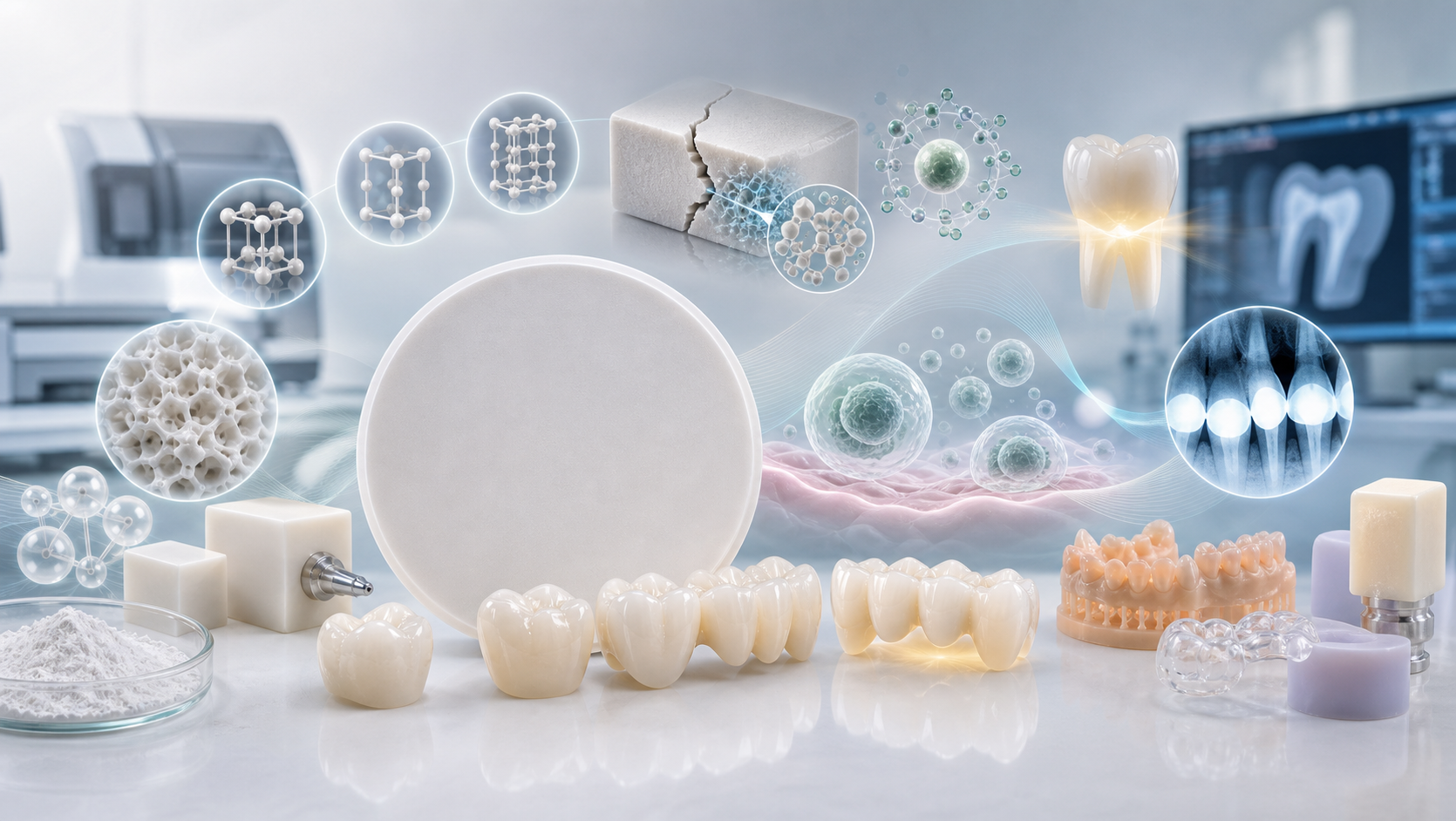
Throughout this module, we explored the scientific principles that transformed zirconia into one of the most important materials in contemporary dentistry.
We understood that zirconia is not a metal, but an advanced technical ceramic whose clinical performance is directly related to its crystalline structure, yttria content, and the microscopic mechanisms that control its strength and optical behavior.
We saw that the evolution of zirconia did not occur only through industrial advances, but mainly through the mastery of Materials Science.
We understood how the monoclinic, tetragonal, and cubic phases influence strength, translucency, and structural stability.
We analyzed the mechanism of Transformation Toughening, responsible for making zirconia one of the strongest ceramics in modern dentistry.
We studied how increasing yttria content made it possible to develop translucent zirconias, creating different categories of materials capable of meeting specific clinical needs.
We also understood that the search for esthetics does not occur without biomechanical consequences and that the balance between strength and translucency remains one of the main challenges in restorative dentistry.
In addition to mechanical aspects, we discussed equally important properties, such as:
- Biocompatibility;
- Interaction with soft tissues;
- Osseointegration;
- Radiopacity;
- Thermal conductivity.
These characteristics help explain why zirconia has come to occupy a central role in restorations, prosthetic abutments, and even ceramic implants.
Perhaps the main conclusion of this module is that there is no single ideal zirconia for every clinical situation.
Restorative success depends on understanding the specific characteristics of each material and applying it correctly according to the functional, biological, and esthetic demands of each case.
More than knowing strength values or translucency levels, the modern professional needs to understand the scientific mechanisms behind these results.
It is precisely this knowledge that makes it possible to make more predictable, safer, and scientifically supported clinical decisions.
Kiwid Education Insight
The strength of zirconia does not originate in the clinic or in the laboratory.
It originates in its microstructure.
Understanding crystalline phases, yttria content, fracture toughness, biocompatibility, and thermal behavior allows us to see zirconia beyond marketing and commercial specifications.
Professionals who master these fundamentals do not select materials only according to translucency or the strength values reported by the manufacturer.
They understand why each material behaves in a certain way and are able to select the best solution for each clinical situation.
It is precisely this scientific understanding that transforms information into predictability.
Next Module
Introduction to Module 2 – Zirconia Processing and Science
So far, we have understood what zirconia is.
From the next module onward, we will understand how it transforms.
Before reaching its final properties, zirconia undergoes a series of critical stages involving machining, sintering, grain growth, volumetric shrinkage, fatigue, hydrothermal aging, and microstructural control.
These processes directly influence:
- Fit accuracy;
- Mechanical strength;
- Clinical longevity;
- Biomechanical behavior of restorations.
In the next module, we will begin this journey by answering a fundamental question:
What really happens to zirconia before sintering?
The answer begins with the so-called Green State of Zirconia, a poorly understood phase, but one that is decisive for the success of any CAD/CAM restoration.
The science of zirconia continues, and now we will enter the heart of its processing.
Member discussion
Start the conversation
Sign in to start commenting.
Sign in