

Why the Future of Dentistry Will Not Be Determined by Materials Alone
Executive Summary
For decades, much of the competition in restorative dentistry focused on material performance. Strength, translucency, mechanical properties, and costs were determining factors in the decisions made by dental practices and laboratories.
However, an important transformation is reshaping the dental industry. Manufacturers have realized that value lies not only in the material or equipment itself, but also in the ability to integrate every stage of the digital workflow.
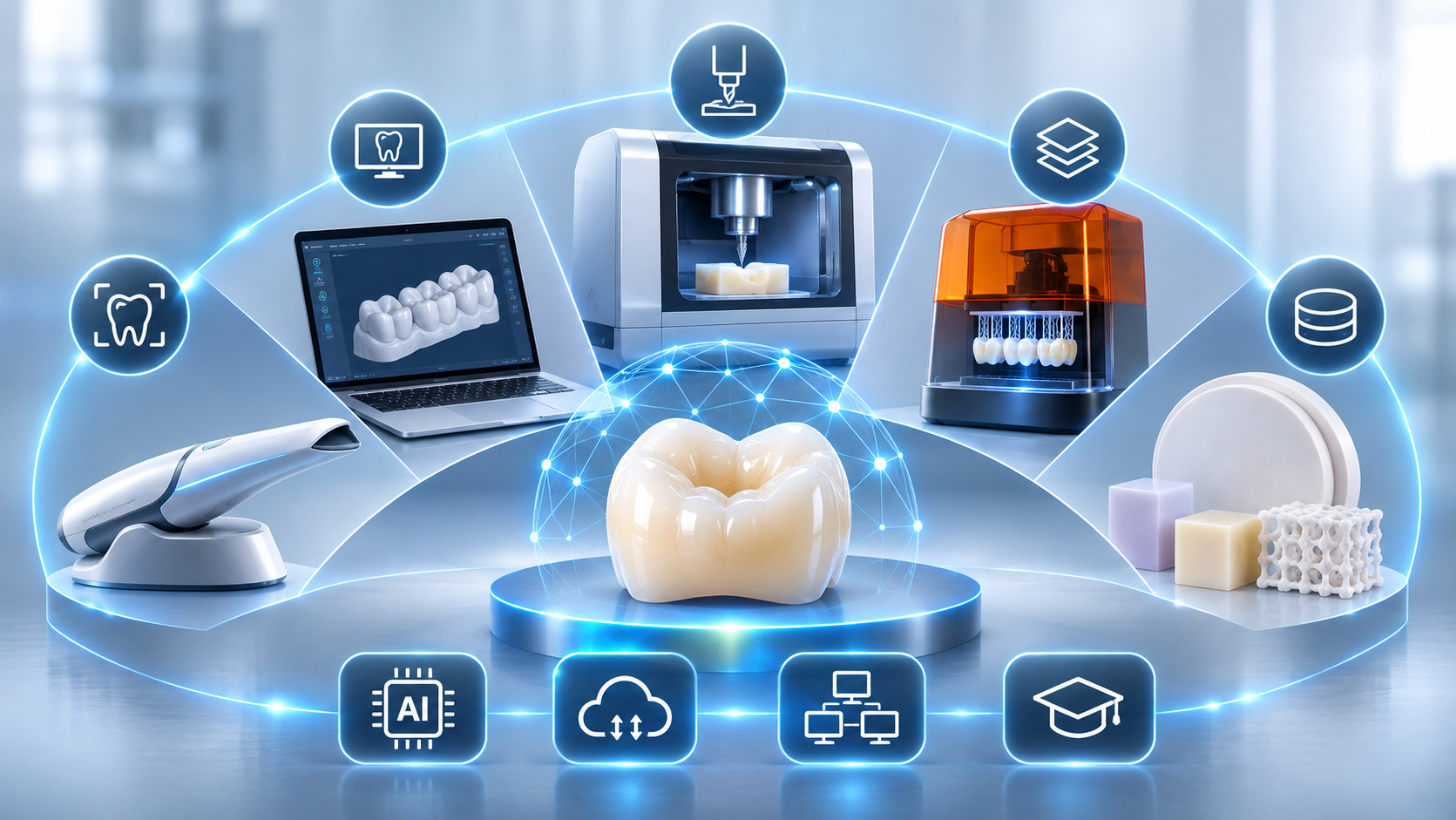
Intraoral scanners, CAD software, milling machines, 3D printers, artificial intelligence, and management platforms are moving away from functioning as independent technologies and toward forming increasingly comprehensive digital ecosystems.
This shift could have an impact on the market as significant as the evolution of restorative biomaterials itself.
From Product Competition to the Battle for Digital Ecosystems
During the first phase of digital dentistry, dental practices and laboratories frequently combined equipment and materials from different manufacturers. It was possible to use a scanner from one brand, design the restoration using another company's software, and manufacture it with third-party equipment and materials.
This model remains in use, but it now coexists with a different strategy: offering integrated solutions that support professionals from data acquisition through restoration manufacturing.
Integration can increase efficiency, simplify processes, and reduce compatibility issues. However, it can also create greater dependence on specific manufacturers, especially when software, equipment, and materials operate within proprietary systems.
The competition, therefore, is not simply about selling more equipment, but about securing a central position in the professional's workflow.
How the Leading Manufacturers Are Positioning Themselves
SHINING 3D has been expanding its presence through the integration of intraoral and laboratory scanners, software, and 3D printing technologies. Its strategy aims to bring digital data acquisition, planning, and manufacturing together within a coordinated workflow. The development of compact solutions, such as the Ceramix-Nano, reinforces its interest in expanding additive manufacturing into the clinical environment.
SprintRay follows a strategy focused primarily on chairside 3D printing. Its equipment, materials, and software aim to simplify the chairside production of various dental devices and restorations, reducing procedural steps and allowing certain treatments to be performed directly in the dental practice.
3Shape has established a strong position through the combination of scanning, software, and clinical-laboratory connectivity. Its strategy emphasizes digital integration while also supporting communication with different manufacturing systems.
Medit, in turn, has gained market share by combining performance, economic competitiveness, and software flexibility. Its approach supports interoperability and the use of different applications within the digital workflow.
Manufacturers traditionally associated with restorative materials are also expanding their activities. Aidite and Yucera, for example, have broadened their portfolios to include CAD/CAM equipment, sintering systems, and other laboratory solutions. Their objective is to participate in a larger portion of the production chain rather than competing exclusively as zirconia suppliers.
Although these companies follow different strategies, they all reflect a common trend: the industry is shifting from selling individual products to offering integrated digital solutions.
Artificial Intelligence Could Redefine This Competition
Artificial intelligence is likely to play an increasingly important role in this transformation.
Systems capable of assisting with margin identification, model segmentation, anatomical crown design, and restorative planning already demonstrate how certain tasks can be automated.
As these tools evolve, integration among scanning, software, and manufacturing may become faster and less dependent on repetitive manual interventions.
However, automation does not eliminate the need for supervision. The quality of outcomes will continue to depend on data accuracy, appropriate material selection, and clinical and laboratory validation.
The competitive advantage may lie precisely in the ability to combine automation, reliability, and freedom of integration.
What Is Changing for Dental Laboratories?
For many years, laboratory investment decisions focused on selecting specific equipment and materials.
Now, a broader question is becoming increasingly important: how can laboratories ensure that different technologies will continue to work efficiently together over the coming years?
Purchasing a scanner, milling machine, or 3D printer requires considering not only its immediate performance, but also compatibility with other systems, software updates, operating costs, and future expansion possibilities.
Integrated ecosystems can simplify production, but excessively closed systems may also limit the freedom to choose materials and suppliers.
For this reason, the laboratory of the future will need to be not only a user of digital equipment, but also a manager of technologies, processes, and information.
A New Opportunity for Distributors and Educational Centers
This transformation is also changing the role of distributors.
Selling a piece of equipment no longer necessarily marks the end of a commercial relationship. Training, technical support, system integration, and continuing professional education are becoming part of the customer experience.
In this context, companies capable of providing knowledge and ongoing technical assistance can build longer-lasting relationships with dental practices and laboratories.
This perspective also reinforces the importance of initiatives such as Galitech Education and KIWID Education, which seek to connect technological evolution with the scientific fundamentals required for its application.
After all, acquiring a technology does not necessarily mean understanding its possibilities, limitations, and indications.
Knowledge remains the essential element that transforms technological investment into clinical and laboratory outcomes.
The Outlook Through 2030
Over the coming years, the trend is toward increasing integration among equipment, software, and artificial intelligence.
CAD design automation is expected to advance, while 3D printing will continue to expand its applications, including the production of certain definitive restorations.
Cloud-based platforms may also facilitate communication and information sharing among dental practices, laboratories, and production centers.
At the same time, competition between open and proprietary systems is likely to become increasingly important. Integration offered by a single manufacturer may provide greater convenience, but interoperability will remain a strategic factor for professionals who want to preserve their freedom of choice.
The result will probably not be a single dominant model, but rather the coexistence of different ecosystems with varying degrees of integration and openness.
Conclusion
Restorative materials will continue to be fundamental to treatment quality and longevity. However, competition in digital dentistry is moving beyond the individual properties of biomaterials.
The market is increasingly valuing the ability to connect data acquisition, planning, manufacturing, automation, and knowledge within an efficient workflow.
For dental practices and laboratories, this represents an important shift: choosing a technology now also involves choosing the digital environment in which it will be used.
KEI INSIGHT
For many years, one of the main questions asked by dental laboratories was:
“Which is the best zirconia?”
Today, that question remains important, but it is no longer sufficient.
The strategic question has become broader:
“Which digital ecosystem will allow us to produce restorations with greater efficiency, predictability, and technological freedom?”
The future of dentistry will not be determined solely by materials or by the number of available devices.
It will be determined by the ability to integrate technology, science, and knowledge into solutions that truly improve clinical and laboratory outcomes.
Member discussion
Start the conversation
Sign in to start commenting.
Sign in