

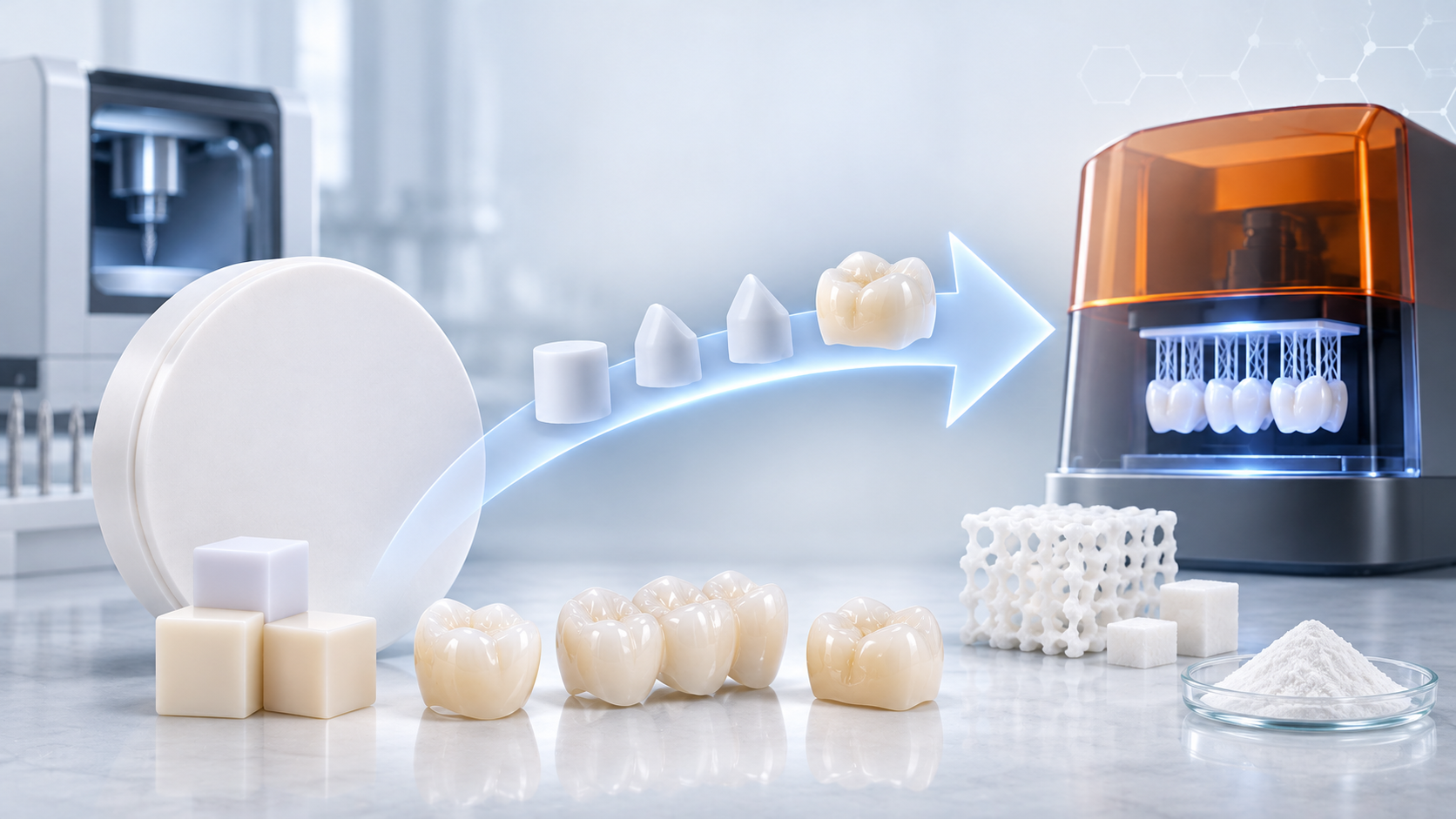
Are We Approaching the End of CAD/CAM Blocks?
How 3D Printing of Definitive Restorations Is Redefining Digital Dentistry
Executive Summary
For more than two decades, milling ceramic blocks and discs has become one of the leading technologies in digital dentistry. Materials such as zirconia and lithium disilicate have transformed the production of restorations, offering accuracy, strength, and predictable clinical outcomes.
However, recent advances in 3D printing, driven by companies such as SprintRay and SHINING 3D, are beginning to challenge this model. Additive manufacturing, previously focused on models, surgical guides, and provisional restorations, is expanding its role in the production of certain definitive restorations.
The question is inevitable: are we witnessing the emergence of a technology that could replace CAD/CAM blocks, or a new alternative that will find its own place in the market?
3D Printing Enters the Definitive Restoration Market
The evolution of digital dentistry was initially marked by the establishment of CAD/CAM systems, followed by the development of increasingly advanced ceramic materials. During this period, milling became a reference standard for manufacturing definitive restorations.
Now, advances in printable restorative materials are beginning to change this scenario. Ceramic particle-reinforced restorative resins, highly filled inorganic composites, and new light-curable formulations are expanding the possibilities of additive manufacturing.
At the same time, research involving 3D-printed zirconia and other ceramics is demonstrating significant progress, although their clinical application still requires further technological and scientific validation.
It is essential to understand that a restoration printed using a ceramic-reinforced resin does not necessarily exhibit the same behavior as a restoration manufactured from zirconia or lithium disilicate. Composition, microstructure, fatigue resistance, and long-term stability remain decisive criteria.
Why Could This Technology Transform the Market?
The main advantage of 3D printing lies in its ability to manufacture restorations through material addition, unlike milling, which removes material from a block or disc during machining.
This process can reduce material waste, facilitate the production of complex geometries, and allow multiple restorations to be manufactured simultaneously. In addition, compact devices are making certain chairside applications more accessible.
However, economic comparisons must consider the entire process. Materials, cleaning, post-curing, finishing, and quality control directly influence the final production cost and time.
3D printing also faces challenges related to dimensional stability, mechanical strength, wear, optical behavior, and clinical durability. For many printed restorative materials, long-term evidence remains limited.
The growth of this technology will depend less on promises of speed and more on demonstrating reliable clinical outcomes.
What Will Happen to Zirconia and Lithium Disilicate?
The arrival of definitive 3D-printed restorations does not mean that CAD/CAM materials are about to disappear.
Milled zirconia continues to offer important advantages in applications requiring high mechanical strength, particularly in certain posterior restorations, long-span prostheses, and implant-supported rehabilitations.
Lithium disilicate, in turn, offers optical properties and a body of clinical evidence that support its use in various restorative indications.
3D printing may gain market share primarily in selected applications, such as single crowns and partial restorations, provided that the materials and protocols used demonstrate performance compatible with clinical requirements.
The most likely scenario is a gradual redistribution of clinical indications, rather than the complete replacement of one technology by another.
The Laboratory of the Future Will Be Hybrid
The expansion of additive manufacturing points toward an important change in laboratory organization.
Rather than choosing exclusively between milling and 3D printing, professionals may combine both technologies according to material characteristics, clinical indications, and production requirements.
This integration will also be accompanied by advances in CAD software, artificial intelligence, and automated manufacturing systems.
For dental practices and laboratories, competitive advantage will not simply lie in acquiring a printer or milling machine, but in the ability to select the most appropriate technology for each situation.
The most efficient laboratory will be the one that understands the possibilities and limitations of both processes.
Conclusion
3D printing is entering a new stage in restorative dentistry, expanding its possibilities beyond provisional applications and traditional laboratory uses.
However, the established clinical performance of CAD/CAM blocks and zirconia discs continues to represent an important advantage in several indications.
The future will probably be characterized by the coexistence of these technologies, with greater digital integration and increasing automation.
KEI INSIGHT
For many years, the evolution of digital dentistry focused on producing increasingly better restorations through milling. Now, 3D printing is beginning to offer new pathways toward achieving the same objective.
Perhaps we are not approaching the end of CAD/CAM blocks, but rather the end of an era in which milling was virtually the only well-established digital alternative for producing definitive ceramic restorations.
The next major transformation will not be about choosing between milling and printing, but about understanding when, why, and with which material each technology should be used.
Member discussion
Start the conversation
Sign in to start commenting.
Sign in