

How SHINING 3D’s Ceramix-Nano Could Transform Digital Dentistry
Executive Summary
During SHINING 3D’s recent global product launches, one device attracted particular attention across the digital dental industry.
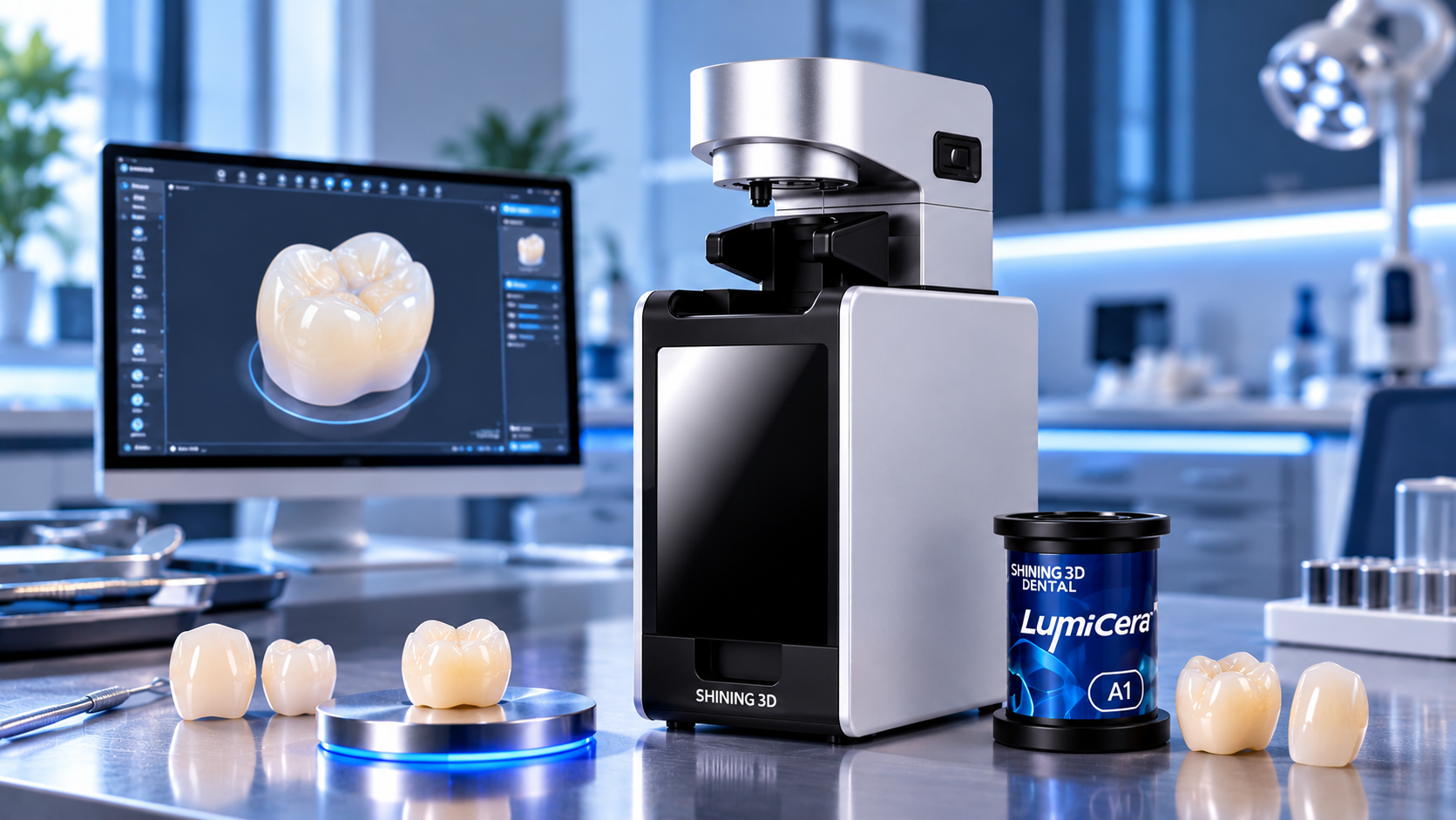
The new Ceramix-Nano was introduced as an ultra-compact chairside printer capable of producing definitive restorations directly in the dental practice within just a few minutes.
Weighing approximately 2 kg and with dimensions that allow it to be carried in a backpack, the Ceramix-Nano represents more than a simple technological advancement.
It may be one of the first concrete signs of a transition from the traditional milling-based workflow to a new model based on chairside 3D printing.
The question that arises is simple:
Are we witnessing the beginning of a new era for definitive restorations?
What Is the Ceramix-Nano?
The Ceramix-Nano is a printer developed by SHINING 3D specifically for producing definitive restorations in a clinical setting.
According to the manufacturer, the system was designed to integrate:
- Intraoral scanning;
- Automated design using artificial intelligence;
- 3D printing;
- Light curing;
- Clinical finishing.
All within an extremely simplified digital workflow.
The objective is to enable the delivery of definitive restorations in a single appointment.
The Real Innovation Is Not the Printer
Although its compact size is impressive, the true distinguishing feature lies in the material used.
SHINING 3D has developed a new material called:
LumiCera™
This is a highly ceramic-filled resin developed specifically for permanent restorations.
Reported Characteristics
- More than 55% ceramic filler content;
- Flexural strength of approximately 200 MPa;
- FDA clearance for definitive restorations;
- High color stability;
- Simplified polishing.
The material is currently available in several clinical shades, and new versions with different translucency levels are already under development.
How Long Does It Take?
According to the data presented by the company:
Even when additional clinical steps are considered, the entire workflow can be completed in a single appointment.
What Can Be Produced?
The Ceramix-Nano was developed to produce:
- Single crowns;
- Veneers;
- Inlays;
- Onlays;
- Minimally invasive restorations;
- Small adhesive prostheses.
The current focus is clearly directed toward single-unit restorations and low-complexity cases.
The New Competition in Digital Dentistry
For many years, digital evolution was driven by the following workflow:
Scanner → CAD → Milling Machine
Beginning in 2026, a new model is emerging:
Scanner → AI → 3D Printer → Definitive Restoration
This change may seem subtle, but it has profound implications.
Manufacturing becomes less dependent on heavy equipment, milling burs, mechanical maintenance, and inventories of ceramic blocks.
The workflow becomes more compact, automated, and potentially more accessible.
What Does This Mean for Dental Laboratories?
At this stage, the technology does not appear to represent a direct threat to multilayer zirconia.
Zirconia continues to offer important advantages in:
- Mechanical strength;
- Long-span bridges;
- Complex rehabilitations;
- Long-term clinical stability.
However, the situation may be different for:
- Single crowns;
- Inlays;
- Onlays;
- Veneers;
- High-productivity chairside treatments.
If clinical acceptance is positive, some of these cases may gradually shift toward 3D-printed workflows.
What Does This Mean for Dentists?
The concept is extremely attractive.
Producing definitive restorations in a single appointment means:
- Fewer patient visits;
- Greater patient convenience;
- Simplified logistics;
- Increased clinical productivity.
The challenge will continue to be the long-term scientific validation of these new materials.
The Real Industry Shift
More important than analyzing a specific printer is understanding the direction of the market.
Major manufacturers are no longer competing solely on materials.
The new competition involves:
- Scanners;
- CAD software;
- Artificial intelligence;
- 3D printing;
- Proprietary materials;
- Complete digital ecosystems.
The Ceramix-Nano is another clear example of this transformation.
Strategic Impact on Dental Practices and Laboratories (2026–2030)
The Ceramix-Nano should be analyzed not only as a new printer, but also as an indicator of the strategic direction of digital dentistry.
If clinical and scientific results confirm current expectations, the coming years may be marked by a gradual change in the profile of single-unit restorations produced in dental practices.
For Dental Practices
The main opportunities include:
- Reduced overall treatment time;
- Greater patient convenience;
- Reduced dependence on multiple appointments;
- Increased clinical productivity;
- Greater integration among scanning, planning, and restoration delivery.
The concept of same-day dentistry may become increasingly accessible to dental practices of different sizes.
For Dental Laboratories
The scenario is different.
Simple single-unit restorations may face increasing competition from chairside workflows.
On the other hand, more complex areas will continue to require specialized technical knowledge, including:
- Extensive rehabilitations;
- Implant-supported prostheses;
- Ceramic layering;
- High-performance multilayer zirconia;
- Advanced esthetic planning;
- Full-arch cases.
The trend suggests that laboratories will need to progressively transition from a volume-based model toward one based on specialization, technical differentiation, and digital integration.
What Should We Watch Over the Coming Years?
The main indicators that will determine the success of this technology include:
- Long-term clinical evidence;
- Color stability;
- Wear resistance;
- Behavior under masticatory fatigue;
- Professional acceptance;
- Cost per restoration produced;
- Evolution of printable restorative materials.
The speed of adoption will depend much more on actual clinical performance than on the technical specifications reported by manufacturers.
Strategic Conclusion
The discussion should not be whether the Ceramix-Nano will replace zirconia or milling machines.
The more relevant question is:
Which procedures will be performed using 3D printing five years from now, and which will continue to depend on milling?
Current indications suggest that 3D printing will initially expand into single-unit restorations and low-complexity procedures.
Meanwhile, materials such as zirconia will continue to dominate cases requiring maximum mechanical strength, predictability, and clinical longevity.
The true transformation will probably not involve replacing one technology with another, but rather the coexistence of different digital workflows, each occupying the area in which it offers the greatest clinical and economic efficiency.
KEI INSIGHT
For years, the question was:
“Which is the best milling machine?”
In the coming years, the question may become:
“Will we still need a milling machine for every case?”
The Ceramix-Nano will probably not replace zirconia or traditional laboratory workflows in the short term.
However, its launch reinforces an increasingly evident trend:
Digital dentistry is shifting from a milling-based era toward a 3D printing-based era.
Perhaps we are witnessing the first steps of a transformation similar to the one that occurred when intraoral scanners began replacing conventional impressions.
Member discussion
Start the conversation
Sign in to start commenting.
Sign in