

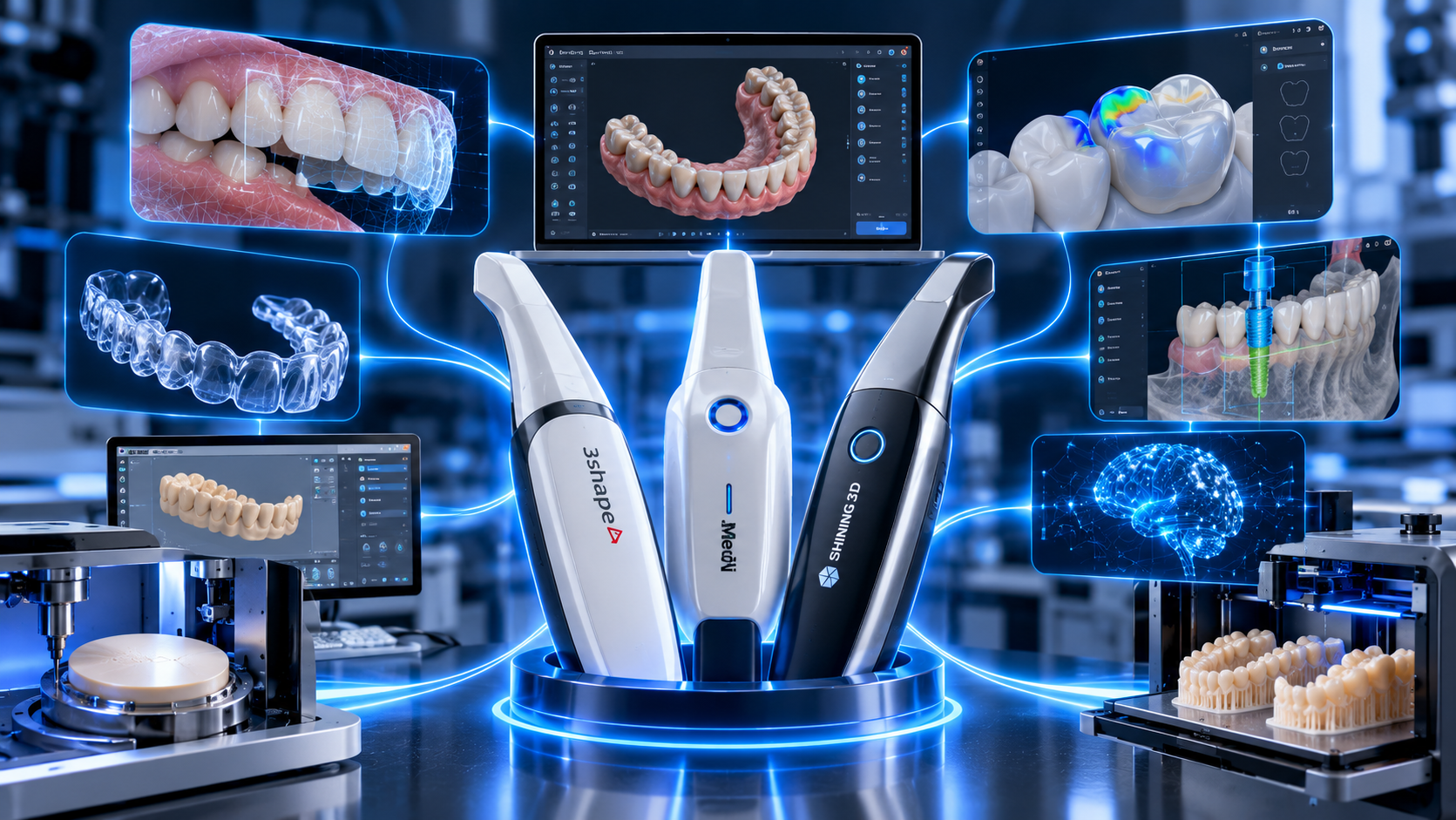
The New Intraoral Scanner Competition
How 3Shape, Medit, and Digital Ecosystems Are Transforming Dental Practices and Laboratories
Executive Summary
For many years, the intraoral scanner was considered simply an alternative to conventional impressions. Today, this perspective has changed profoundly. The scanner has become one of the main gateways to digital dentistry, connecting treatment planning, CAD/CAM, 3D printing, implant dentistry, and artificial intelligence.
This transformation is changing the way manufacturers compete. The competition is no longer based only on accuracy, speed, or price, but on the ability to offer integrated digital ecosystems.
3Shape, Medit, and Shining 3D: Three Strategies
3Shape has consolidated its presence in the premium segment through equipment, software, and integrated solutions for dental practices and laboratories. Its strategy focuses on the digital experience and the connection between different stages of treatment.
Medit has gained market share by combining performance, software flexibility, and economic competitiveness. Its approach supports the democratization of intraoral scanning and integration with different digital systems.
Shining 3D, in turn, focuses on connecting scanning, planning, and manufacturing technologies, particularly 3D printing, with the goal of offering integrated workflows at competitive costs.
Although they follow different strategies, all three companies reflect the same transformation: value is shifting away from the individual device and toward the digital ecosystem.
Artificial Intelligence Is Changing the Role of the Scanner
Scanners are evolving into systems capable of assisting not only with image acquisition, but also with data interpretation and processing.
Identification of scanning errors, recognition of anatomical structures, assistance with margin definition, and integration with planning software are important applications of this evolution.
In laboratories, artificial intelligence is also beginning to automate tasks related to CAD design, dental morphology selection, and the organization of production processes.
The goal is not simply to replace human intervention, but to reduce repetitive tasks and increase the efficiency of the digital workflow.
The Impact on Dental Practices and Laboratories
Digitalization is changing the relationship between clinicians and dental technicians. Immediate file transfer, digital communication, and integration with manufacturing systems can reduce operational steps and improve productivity.
However, owning digital equipment does not necessarily mean working efficiently. Data quality, software compatibility, correct material selection, and process standardization remain essential.
The competitive laboratory will be the one capable of integrating scanning, CAD/CAM, milling, 3D printing, and artificial intelligence into a predictable and economically sustainable workflow.
Conclusion
The evolution of intraoral scanners demonstrates that digital dentistry is entering a new phase. Accuracy and performance remain important, but integration, software, and artificial intelligence are taking on an increasingly strategic role.
The decision to acquire a scanner is no longer simply about choosing a device. It is becoming a decision about choosing a workflow.
KEI INSIGHT
The first phase of digital dentistry was defined by the acquisition of equipment. The second was defined by mastering these technologies. Now, we are entering the era of integrated digital ecosystems.
The future does not necessarily belong to those who own more technology, but to those who know how to connect equipment, knowledge, and processes to achieve better outcomes.
Next Edition – KEI 07
The World’s Smallest Chairside Printer?
How SHINING 3D’s Ceramix-Nano Could Transform Digital Dentistry
Among SHINING 3D’s recent global product launches, one device drew particular attention across the digital dental industry.
The new Ceramix-Nano was introduced as an ultra-compact chairside printer capable of producing definitive restorations directly in the dental practice within just a few minutes.
Member discussion
Start the conversation
Sign in to start commenting.
Sign in