

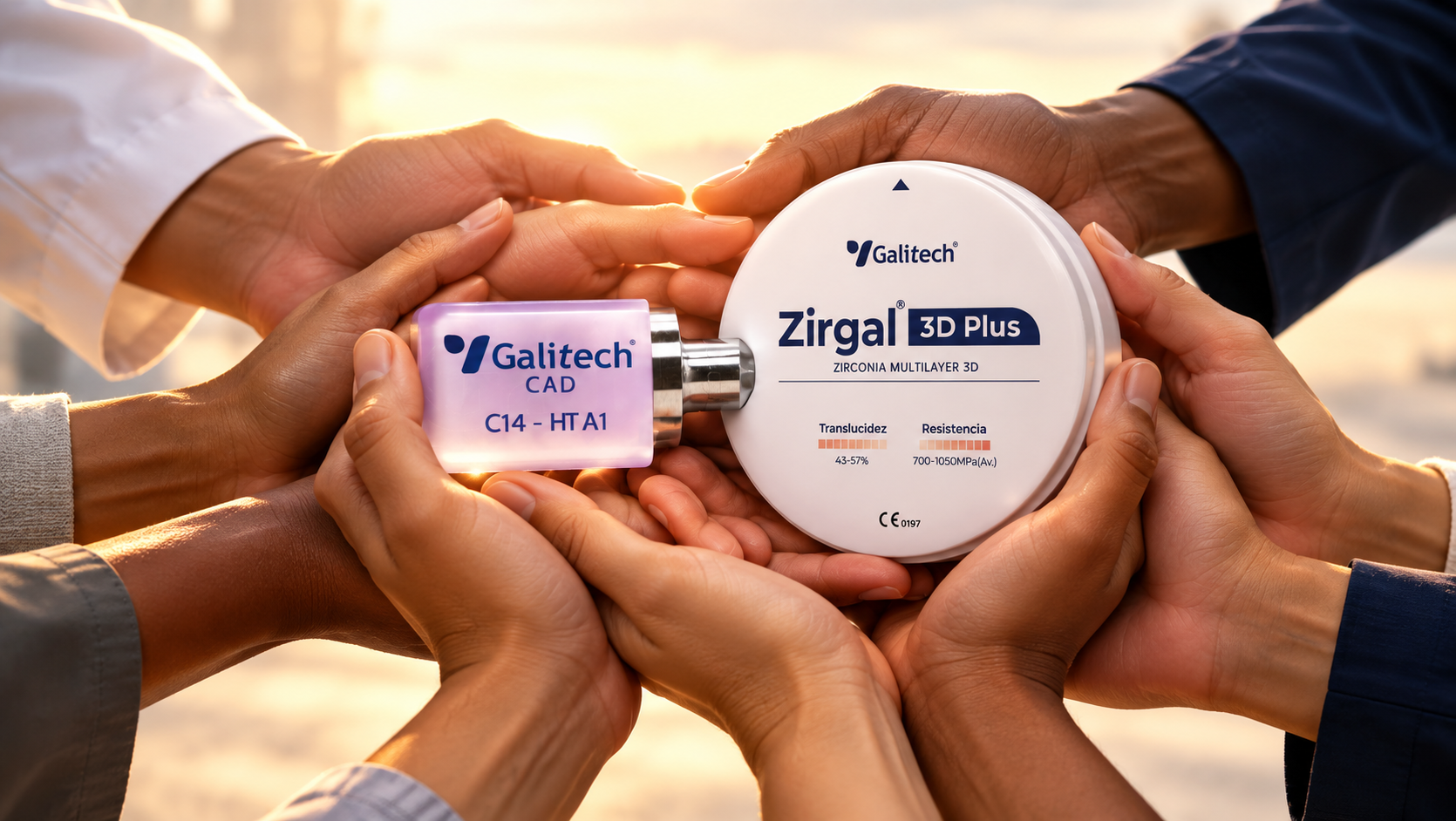
How Dentistry Is Moving from Competition Between Materials to Personalized Indications
Executive Summary
For almost twenty years, the dental industry promoted a simple narrative: Lithium disilicate for esthetics and zirconia for strength.
This division helped manufacturers, distributors, and clinicians quickly understand the indications of each material.
But in 2026, this logic is beginning to disappear. The market is moving toward a new model, and the discussion is no longer: “Which material is better?” It has become: “Which material delivers greater value for each clinical situation?”
This shift is redefining corporate strategies, product positioning, and educational programs around the world.
The Most Important Movement
Manufacturers have realized that the next decade will not be dominated by a single material.
It will be dominated by the ability to offer multiple solutions for different clinical needs.
The market is moving away from the logic of substitution and adopting the logic of complementarity.
How Companies Are Responding
Zirconia Manufacturers
In recent years, they have invested heavily in:
- esthetics;
- multilayer systems;
- workflow simplification;
- monolithic restorations.
Objective: Expand indications traditionally associated with glass ceramics.
Lithium Disilicate Manufacturers
The strategy has been different.
Rather than competing directly with zirconia, the focus has shifted toward:
- conservative dentistry;
- biomimetics;
- minimal intervention;
- adhesion.
Objective: Strengthen niches in which preservation of tooth structure is highly valued.
What Is Changing in Dental Laboratories
The most competitive laboratories are reducing their dependence on a single material.
The trend is toward:
- greater diversification;
- personalized protocols;
- integration of multiple technologies.
Competitive advantage is shifting from simply choosing a material to the ability to select the right solution.
The New Strategy of Manufacturers
Historically, companies sold materials.
Today, they sell concepts.
Examples include:
- biomimetic dentistry;
- simplified digital workflows;
- clinical predictability;
- digital integration.
The product remains important, but the narrative surrounding it has become even more important.
Impact on the Brazilian Market
Brazil has an interesting characteristic: dental laboratories and clinics operate at a high technical level and have broad access to information.
In this environment, it is becoming increasingly difficult to compete solely on technical specifications.
The market increasingly values:
- support;
- education;
- training;
- predictability.
This favors companies that are able to build long-term relationships with their customers.
Commercial Application
For distributors and manufacturers, the main opportunity is not to convince the market that one material should replace another.
The opportunity lies in helping clinicians and laboratories understand when each solution is most appropriate.
Companies that act as technical consultants will have greater customer-retention potential than those that operate only as suppliers.
What Can We Expect by 2030?
The most likely trend is not the consolidation of a single dominant material.
The trend is toward greater specialization, with each material occupying specific roles within increasingly personalized clinical workflows.
The growth of digital dentistry is likely to accelerate this movement even further.
KEI INSIGHT
Perhaps the greatest change of the next decade will be cultural.
For years, the market tried to determine which material would win the competition.
But the most mature markets are showing exactly the opposite.
The winners will not be the materials themselves, but the professionals and companies capable of understanding when to use each one.
The future does not belong to lithium disilicate. The future does not belong to zirconia. The future belongs to personalized indications.
Next Edition – KEI 06
The Scanner Has Become the Center of Digital Dentistry
How 3Shape, Medit, and New Digital Ecosystems Are Transforming Dental Practices and Laboratories
- The transformation of the scanner into a digital platform
- How manufacturers are building complete ecosystems
- The role of artificial intelligence in scanners
- Integration between dental practice, laboratory, and CAD/CAM
- The growth of connected dentistry
- The impact on digital laboratories and distributors
This edition analyzes why the next competition in digital dentistry will not be about scanner accuracy, but about the ability to integrate the entire digital workflow into a single platform.
Member discussion
Start the conversation
Sign in to start commenting.
Sign in