

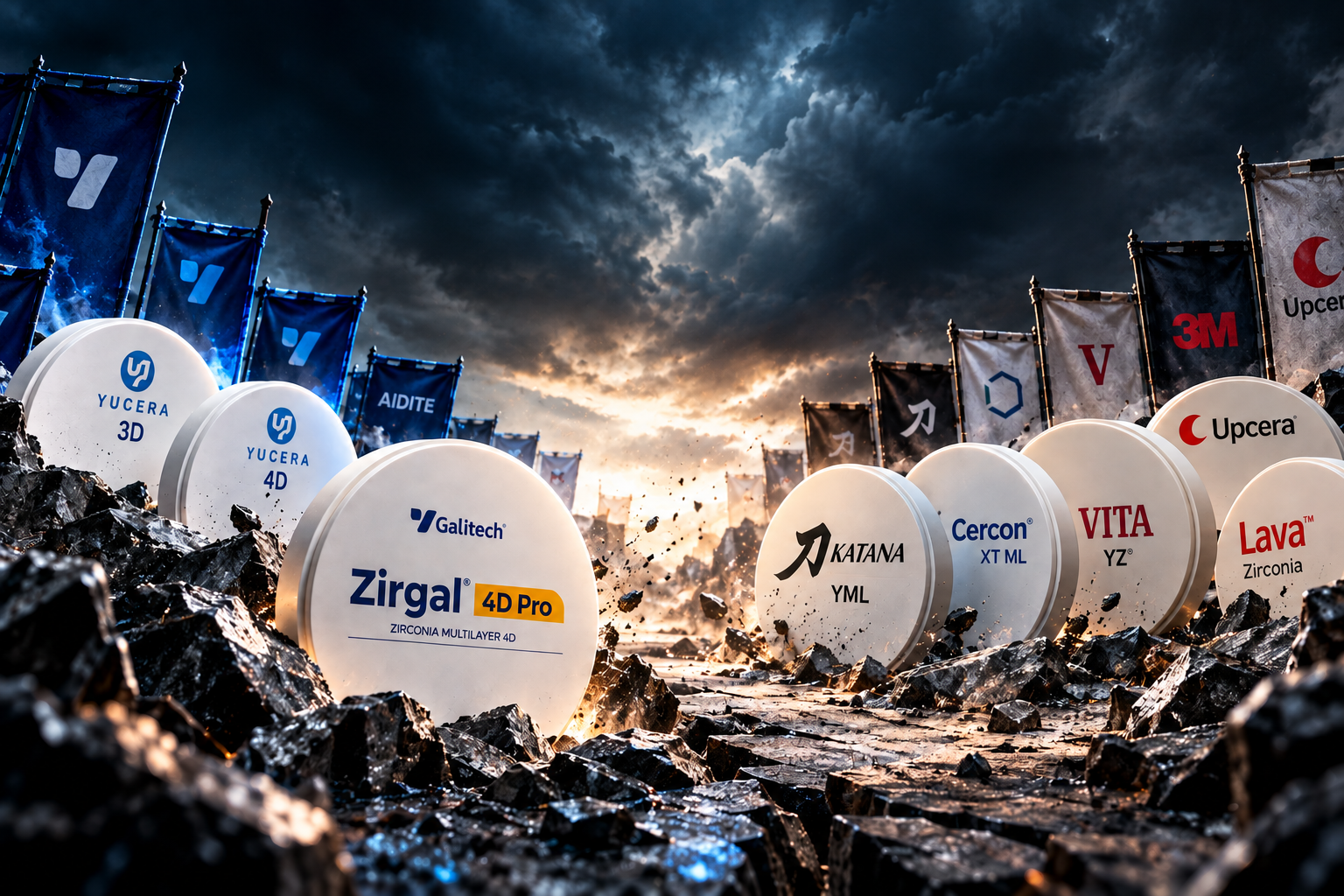
How Aidite, Yucera, Upcera, and European Manufacturers Are Competing for the Global Market
1. Executive Summary
Over the past five years, the global zirconia market has undergone a profound transformation. Historically dominated by European and Japanese manufacturers, the sector is now facing increasing pressure from Chinese manufacturers, which today compete not only on price, but also on technology, advanced multilayer systems, rapid sintering, scanners, milling machines, 3D printing, and complete digital ecosystems.
The major change in 2026 is that the competition is no longer simply about “who sells the cheapest zirconia?” but rather “who offers the most complete digital solution?”
This shift helps explain why material manufacturers are expanding their activities far beyond zirconia discs and seeking to integrate different stages of the digital workflow.
2. The Major Groups Competing in the Market
The current market can be viewed through three major industrial hubs, each with distinct strategies.
Chinese Manufacturers
Among the main names are:
- Aidite;
- Yucera;
- Upcera.
Their objective is to rapidly expand global market share, strengthen international distribution, and offer increasingly complete solutions for the digital workflow.
Japanese Manufacturers
Kuraray Noritake, with its Katana line, maintains a relevant position based on technological development, precision, and material stability.
European Manufacturers
Among the main players are:
- Ivoclar;
- Zirkonzahn;
- VITA Zahnfabrik.
These companies continue to associate their positioning with quality, scientific documentation, tradition, and brand strength, maintaining an important presence in the premium segment.
3. Aidite’s Strategy
Aidite has moved beyond operating solely as a zirconia manufacturer and has begun building a much broader portfolio for digital laboratories.
Today, its offering includes:
- zirconia;
- milling machines;
- 3D printers;
- furnaces;
- scanners;
- digital platforms.
This strategy positions the company not only as a material supplier, but as a potential provider of integrated solutions for the digital laboratory.
Technical Highlight — 3D Pro Zir
Aidite has been promoting its multilayer line for different indications, including single crowns, bridges, and more extensive rehabilitations.
Among the characteristics promoted are:
- strength of up to 1100 MPa;
- 4Y–5Y structure;
- focus on biomimetics;
- transition between different layers.
New Trend — 3D Pro Zir MAX
The company is also promoting the 3D Pro Zir MAX line for situations involving greater functional demand, including implants, extensive prostheses, and full-arch protocols.
Among the data reported by the company are:
- flexural strength of 1300 MPa;
- 4Y multilayer composition;
- translucency of up to 48%.
This movement demonstrates a clear strategy: expanding the presence of multilayer zirconia into situations that require greater biomechanical reserve.
4. Yucera’s Strategy
Yucera follows a different strategy, based on a combination of product variety, multilayer technology, and economic competitiveness.
The company has been expanding its international presence by offering materials intended for different clinical and laboratory indications, with strong attention to the balance between performance and cost.
Highlight — Yucera 4D Pro
Among the characteristics promoted for the line are:
- strength gradient;
- translucency gradient;
- transition across multiple layers;
- strength ranging from approximately 600 to 1200 MPa, depending on the region of the disc.
This concept seeks to combine optical behavior and mechanical properties in different regions of the same restoration.
Opportunity for Distributors
Yucera aims to occupy an intermediate position between traditional premium products and lower-cost Asian materials.
This positioning may be especially interesting in markets such as Spain and Portugal, where laboratories are increasingly seeking to balance quality, productivity, and economic competitiveness.
5. Upcera’s Strategy
Upcera has also been adopting an aggressive internationalization strategy.
One of the movements highlighted by the company is the expansion of its regulatory and commercial presence in the European market.
At the same time, the brand has been introducing a new technological platform called Aevra, associated with new manufacturing processes and the development of materials focused on both esthetics and mechanical performance.
The company has also been strengthening its participation in international trade shows, using these events as platforms to expand its presence outside Asia and introduce new generations of products.
Upcera’s movement reinforces a broader trend: Chinese manufacturers are no longer competing on price alone. They are investing in technology, branding, certification, and international expansion.
6. How European Manufacturers Are Responding
While Chinese manufacturers are rapidly expanding their international presence, European companies continue to base their strategies on reliability, scientific documentation, brand strength, and integration with well-established CAD/CAM systems.
Ivoclar
Ivoclar continues to leverage the strength of the IPS e.max ZirCAD family, maintaining a focus on predictability, different material options, and premium positioning.
Zirkonzahn
Zirkonzahn maintains a particularly strong presence in extensive rehabilitations, full-arch protocols, and highly technical laboratories.
Overall, the European strategy does not appear to be focused on competing exclusively on price, but rather on preserving value through brand, documentation, system integration, and trust built over time.
7. What Is Really Happening in This Competition?
There is no single dominant strategy.
Chinese manufacturers are seeking to gain market share through rapid development, digital integration, portfolio expansion, and economic competitiveness.
European and Japanese manufacturers, in contrast, continue to base much of their positioning on reputation, scientific documentation, predictability, and customer loyalty.
The most interesting aspect of this competition is that it is no longer taking place only at the material level.
Competition is shifting from the zirconia disc itself to the ecosystem surrounding it.
8. Impact on Spanish Laboratories
For Spanish laboratories, this transformation significantly expands the range of available options.
Today, it is possible to access materials from different origins, price levels, optical characteristics, and mechanical properties, as well as technologies that were previously concentrated mainly in the premium segment.
As a result, competition is no longer based only on material price and increasingly involves factors such as:
- productivity;
- digital workflow efficiency;
- technical support;
- education;
- predictability;
- integration among different technologies.
The greater the variety of materials available, the more important it becomes to know how to select and use each system correctly.
9. Galitech Commercial Application
For Galitech, the opportunity lies precisely in positioning its materials within this new logic: not simply as zirconia discs, but as part of a solution focused on clinical and laboratory predictability.
Zirgal 3D Pro
Positioning:
- high strength;
- biomechanical safety;
- more extensive rehabilitations.
Zirgal 4D Plus
Positioning:
- balance between esthetics and function;
- advanced monolithic restorations;
- contemporary crowns and bridges.
In this scenario, the strongest commercial message is no longer simply:
“Our zirconia is stronger.”
It becomes:
“Our solution delivers clinical and laboratory predictability.”
KEI INSIGHT
The zirconia war will not be decided solely by the manufacturer that presents the highest flexural strength value.
The competition is shifting toward something much broader: the ability to integrate material, scanner, CAD, milling, 3D printing, artificial intelligence, and technological support within a coherent workflow.
The future will probably not belong only to the best materials. It will belong to the best ecosystems.
Next Edition — KEI 05
The End of the War Between Lithium Disilicate and Zirconia
How Dentistry Is Moving from Competition Between Materials to Personalized Indications
For many years, zirconia and lithium disilicate were presented almost as competing materials.
The evolution of Materials Science and adhesive dentistry is revealing a different scenario: increasingly, the decision is moving away from “which material is better?” and toward “which material best meets the needs of this case?”
In the next edition, we will analyze:
- how manufacturers are repositioning their materials;
- the evolution of Ivoclar’s strategies and those of zirconia manufacturers;
- why dentistry is moving away from the logic of “one material versus another”;
- the growth of biomimetic concepts;
- the impact of these changes on laboratories and distributors;
- the future of restorative materials through 2030.
The discussion is shifting away from which material wins the competition and toward which solution offers the greatest biological, mechanical, and esthetic value for each clinical situation.
Member discussion
Start the conversation
Sign in to start commenting.
Sign in