

1. Executive Summary
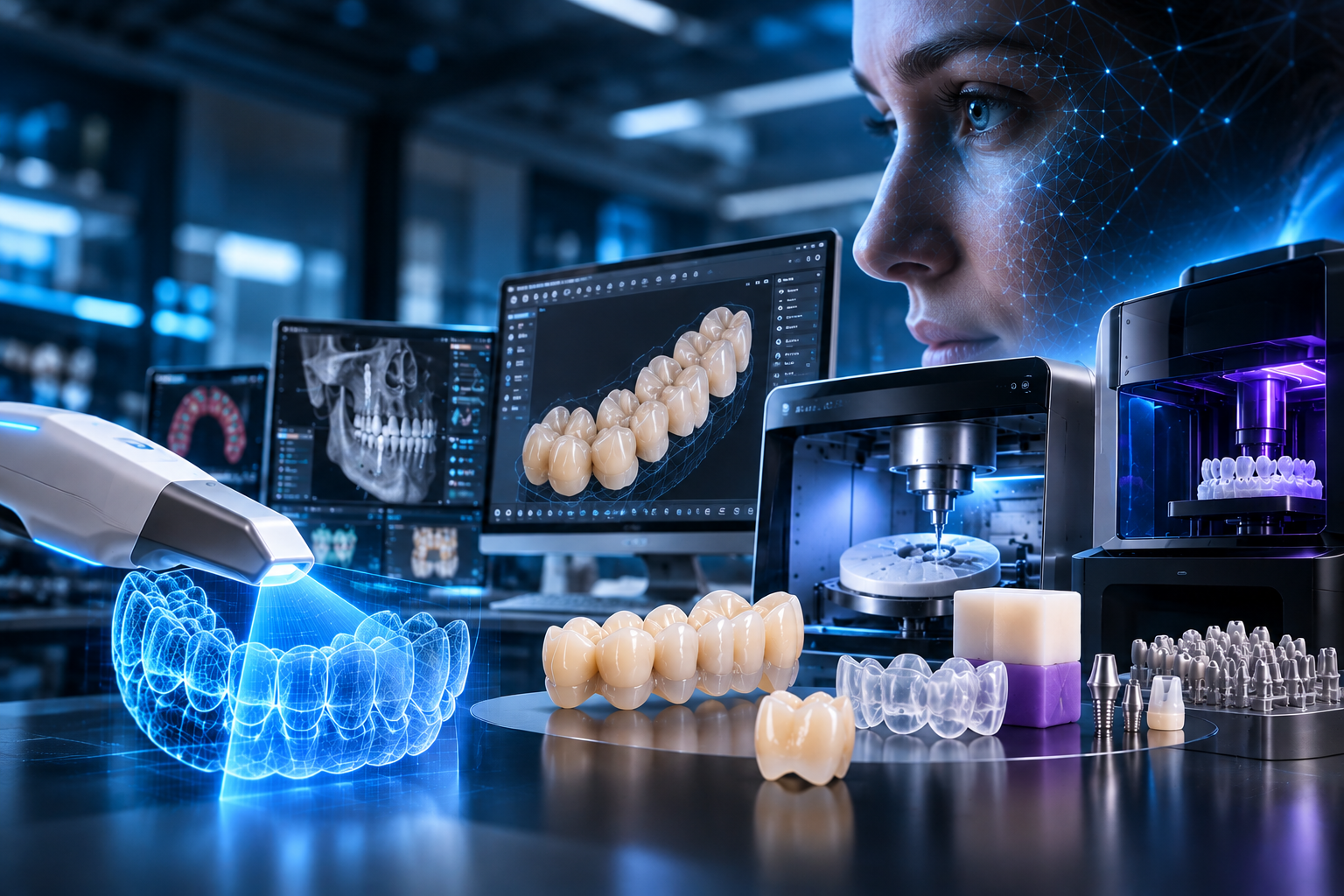
Digital dentistry is undergoing one of its greatest transformations since the introduction of CAD/CAM. The convergence of intraoral scanners, artificial intelligence, CAD/CAM, 3D printing, laboratory automation, and cloud platforms is profoundly changing the way dental practices and laboratories produce restorations.
The market focus is no longer limited to the restorative material itself and now includes the efficiency of the entire digital workflow.
2. What Is Changing in the Market
First Wave — 2000–2015
Partial Digitalization
This period was characterized by the progressive introduction of digital tools, still with limited integration among different systems.
Main characteristics:
- Stand-alone CAD/CAM;
- Laboratory scanners;
- Predominantly manual design;
- Limited integration between equipment and software.
Second Wave — 2015–2025
Integrated Digital Workflow
Digitalization began to connect the dental practice, laboratory, and manufacturing process, making workflows faster and more predictable.
Main characteristics:
- Intraoral scanners;
- CAD software such as exocad;
- 3D printing;
- Milling of multilayer zirconia;
- Greater integration among data acquisition, design, and production.
Third Wave — 2025–2030
Intelligent Workflow
The next stage will be characterized not only by digitalization, but also by automation and by the ability of systems to interpret data and actively participate in the production process.
Main characteristics:
- AI applied to design;
- Laboratory automation;
- Cloud manufacturing;
- Real-time integration between dental practice and laboratory;
- Progressive reduction of repetitive tasks.
3. Key Technologies Redefining the Market
Intraoral Scanners
Intraoral scanners are becoming smaller, faster, more accurate, and progressively integrated with artificial intelligence. Their role is also changing: they are no longer functioning only as substitutes for conventional impressions, but are assuming a central position within the digital ecosystem.
Among the main players in the market are:
- 3Shape;
- Medit;
- Shining 3D.
Artificial Intelligence
Artificial intelligence is already beginning to participate in different stages of the digital restorative workflow, suggesting anatomies, assisting in occlusal optimization, reducing design time, and supporting diagnostic processes.
The next stage is likely to involve the development of increasingly semi-autonomous restorative design systems.
Laboratory Automation
The most competitive laboratories are moving toward more standardized, integrated, and traceable processes, with greater capacity for scalable production.
The competitive advantage is no longer only technical. It is also becoming operational.
4. The Role of Materials
For many years, a large part of dental innovation focused on the development of new zirconias, new lithium disilicates, and new composites.
Today, many of these materials have already reached very high levels of performance. This does not mean that biomaterial development has ended, but rather that competitive differentiation is beginning to shift toward other elements of the system.
Increasingly, value is related to:
- Digital workflow;
- Productivity;
- Integration;
- Predictability;
- Process control.
5. Impact on Dental Laboratories
Laboratories that remain focused exclusively on milling, layering, and traditional production may face increasing competitive pressure as digital workflows become more integrated and automated.
On the other hand, laboratories capable of mastering scanning, CAD, artificial intelligence, 3D printing, and digital communication will be better positioned to increase efficiency, reduce variability, and offer more comprehensive services.
Competitive advantage is likely to depend less and less on a single skill and increasingly on the ability to control the entire workflow.
6. Commercial Application
Market differentiation will not come from price alone. It will increasingly be related to the ability to offer speed, predictability, digital communication, technical support, and continuing education.
In an increasingly connected market, value will not reside only in the product delivered, but also in the experience, support, and efficiency of the entire process.
KEI INSIGHT
The greatest transformation of the next decade will not come from a new zirconia, a new lithium disilicate, or a new printer.
The real change will lie in the integration of all these technologies.
The laboratory that stands out will not necessarily be the one with the best material, but the one capable of building the best workflow.
Next Edition — KEI 04
The Zirconia War
Major international trade shows do not reveal only new technologies. They also show which companies are leading the transformation of digital dentistry and which strategies are shaping the future of the market.
In recent years, the race for global leadership in zirconia has become one of the most intense in the dental industry. Chinese manufacturers are advancing rapidly through digital integration and international expansion, while European and Japanese companies continue to rely on tradition, scientific documentation, and premium positioning.
The question is not simply who sells more. It is about understanding which industrial, technological, and commercial models are gaining strength and how this may affect laboratories, distributors, and dental practices.
In the next edition of Kiwid Education Intelligence, we will analyze the strategic movements that are redefining the global zirconia market and the opportunities emerging for professionals who are following this transformation.
Member discussion
Start the conversation
Sign in to start commenting.
Sign in