

Which technological, scientific, and economic movements are redefining the future of digital dentistry?
Introduction
Dentistry is going through one of the fastest periods of transformation in its history. Artificial intelligence, increasingly advanced intraoral scanners, 3D printing, new materials, and integrated digital workflows are changing the way dental practices, laboratories, and manufacturers operate around the world.
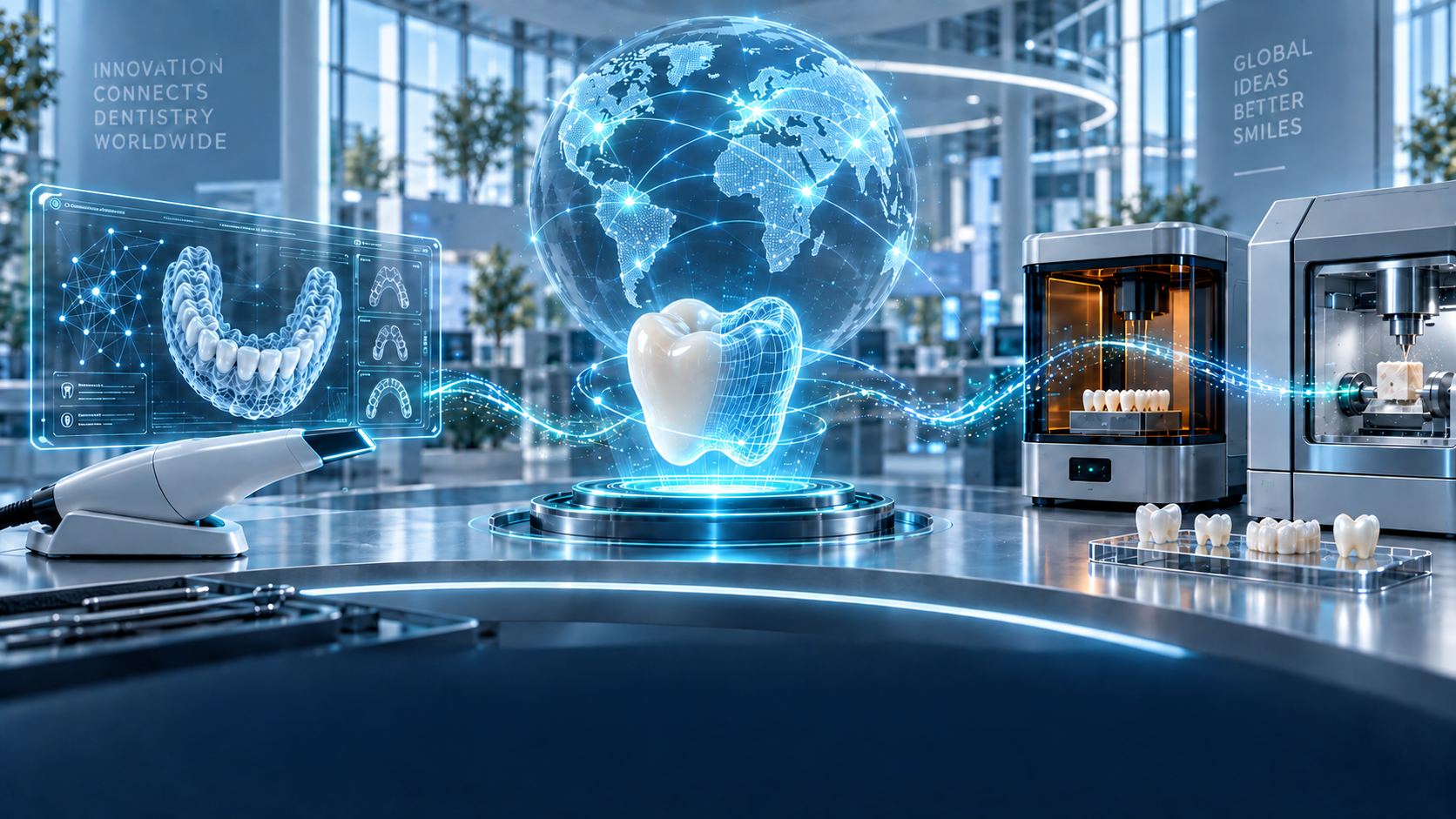
More important than observing each innovation in isolation is understanding how these technologies are beginning to connect. Scanners, CAD, artificial intelligence, milling, 3D printing, cloud-based systems, and automation are progressively moving away from functioning as independent tools and toward forming integrated digital ecosystems.
This convergence is precisely what KEI — Kiwid Education Intelligence seeks to monitor and analyze. In this edition, we examine some of the main technological and economic movements that may influence dentistry over the coming years, not only to identify new developments, but to understand which transformations may truly change clinical practice, laboratory production, and industry competitiveness.
What This Edition Highlights
In this edition, we analyze the major international events that serve as showcases for dental innovation, the integration of artificial intelligence into the CAD/CAM workflow, the evolution of the intraoral scanner market, advances in zirconia 3D printing, the expansion of the chairside concept, and the growing integration among software, equipment, and digital manufacturing.
The goal of KEI is not simply to follow what is happening.
It is to interpret which movements may truly influence dentistry in the years ahead.
International Events: Where the Next Trends Appear First
IDS 2027 — Cologne, Germany
The next edition of IDS already has confirmed dates.
Date: March 16–20, 2027
Location: Cologne, Germany
Among the topics that are likely to have a strong presence are:
- artificial intelligence applied to the digital workflow;
- intraoral scanners;
- CAD/CAM integration;
- 3D printing for definitive applications;
- ceramics produced through additive manufacturing;
- laboratory automation;
- cloud-based workflows.
KEI INSIGHT
The importance of IDS lies not only in the product launches presented during the event.
Events of this scale make it possible to observe where the industry is directing its investments.
IDS 2027 may be especially relevant for understanding to what extent artificial intelligence, automation, scanners, software, and digital manufacturing are already converging into increasingly integrated platforms.
Asia-Pacific: An Increasingly Strategic Hub
The dental market in the Asia-Pacific region has gained significant importance in recent years.
In addition to the rapid adoption of digital technologies, the region is home to a growing number of manufacturers of scanners, CAD/CAM equipment, 3D printers, and restorative materials.
Events such as IDEM help reveal this transformation.
More than simply following new products, it is important to observe the speed at which Asian manufacturers are expanding their international presence and competing in areas that, for many years, were concentrated mainly among European, North American, and Japanese companies.
KEI INSIGHT
One of the most important changes in the dental industry is not only technological.
It is also geographic.
Innovation and manufacturing capabilities are becoming increasingly distributed worldwide, increasing competition and accelerating the development cycles of new products.
Artificial Intelligence Enters the CAD/CAM Workflow
For many years, artificial intelligence in dentistry was associated mainly with diagnosis and image interpretation.
This scenario is changing.
AI is beginning to participate directly in the digital restorative workflow.
Among the emerging applications are:
- automated crown design;
- recognition of anatomical structures;
- margin identification;
- morphology selection;
- restorative planning;
- integration between scanner and CAD;
- support for clinical and laboratory decision-making.
Clinical and Laboratory Impact
The incorporation of AI into CAD/CAM may help reduce the time spent on design, repetitive tasks, variability among operators, and certain adjustment and review procedures.
This does not mean eliminating clinical or technical knowledge, but rather changing its role.
The greater the automation of repetitive tasks, the greater the importance of supervision, validation, and complex decision-making.
KEI INSIGHT
The deepest impact of artificial intelligence may not lie in replacing professionals, but in changing which tasks truly require human intervention.
Intraoral Scanners: From Impression Devices to Digital Platforms
The global intraoral scanner market continues to expand.
More important than the increasing number of devices is the transformation of their role within digital dentistry.
The main trends include:
- smaller devices;
- faster capture;
- improved soft-tissue scanning;
- integrated artificial intelligence;
- automatic analysis of scan quality;
- cloud-based systems;
- more direct communication between dental practice and laboratory.
The intraoral scanner is progressively moving beyond simply being an alternative to conventional impressions and is becoming the gateway to the entire digital ecosystem.
From the scanner, treatment planning, CAD, communication, manufacturing, and patient follow-up can all be connected.
Zirconia 3D Printing: Real Potential, but Clinical Maturity Is Still Developing
Among the technologies currently generating the greatest interest is additive manufacturing of ceramics.
Zirconia 3D printing already demonstrates interesting possibilities, especially for geometries that may be difficult to produce using conventional methods.
Research lines include different types of restorations and ceramic structures.
The objective is clear: to move ceramic manufacturing toward a more digital, flexible process that is potentially less dependent on subtractive manufacturing.
However, there is still an important gap between technological possibility and clinical predictability.
Current Challenges
Among the main challenges are:
- porosity;
- shrinkage during processing;
- dimensional accuracy;
- internal defects;
- surface finishing;
- final mechanical properties;
- optical behavior;
- sintering;
- repeatability;
- economic feasibility.
For this reason, milling continues to hold a central position in the production of definitive ceramic restorations.
KEI INSIGHT
Perhaps the most interesting question is not:
“Will 3D printing replace milling?”
but rather:
“Which restorations will be more efficiently produced by printing, and which will continue to be better produced by milling?”
The laboratory of the future will probably use both technologies.
New Materials for Additive Manufacturing
Companies specializing in additive manufacturing of ceramics continue to develop new zirconia formulations and processing methods.
Among the objectives are greater toughness, improved stability, higher structural reliability, better process control, and greater industrial predictability.
These advances are important because they demonstrate that the evolution of 3D printing does not depend only on the printers.
The true advancement will occur when equipment, material, software, and thermal processing evolve as a single system.
KEI INSIGHT
Printed zirconia does not yet represent an immediate replacement for milled multilayer discs, but ignoring this technology would be equally mistaken.
Its evolution deserves continuous monitoring, especially in applications where additive manufacturing may offer geometric or production advantages.
Chairside: From Convenience to Digital Strategy
The chairside CAD/CAM concept also continues to evolve.
For many years, its main value proposition was the possibility of producing a restoration in a single appointment.
Today, the concept is broader.
Scanners, software, artificial intelligence, milling, and printing can be integrated into a workflow capable of reducing steps, accelerating treatment, and increasing control over the restorative process.
The main factors driving this movement include:
- digitalization of dental practices;
- reduction in treatment time;
- integrated workflows;
- demand for faster treatments;
- greater integration among scanner, software, and manufacturing.
Chairside dentistry, therefore, is moving beyond being merely a matter of convenience and is becoming part of a broader strategy involving clinical efficiency, patient experience, and control of the restorative workflow.
Integration May Be the Most Important Movement
When we analyze artificial intelligence, scanners, CAD, 3D printing, milling, and cloud-based systems separately, it may appear that we are looking at different technologies.
But perhaps that is not what is really happening.
These technologies are progressively converging.
The workflow is beginning to take on an increasingly integrated structure:
Scanner → Data → Artificial Intelligence → CAD → Manufacturing → Control → Cloud
This integration may be more important to the future of digital dentistry than any individual device.
Conclusion
One trend appears consistently across virtually all of these movements.
The future of digital dentistry will not be defined only by a new material, a new scanner, or a new printer.
It will be defined by the ability to integrate:
- scanners;
- artificial intelligence;
- CAD;
- 3D printing;
- milling;
- automation;
- management systems;
- data;
- cloud-based systems.
Deep knowledge of materials will continue to be fundamental, but it will probably not be enough.
Professionals and laboratories capable of understanding the entire digital workflow will be in a better position to select technologies, control processes, and transform innovation into predictable clinical outcomes.
KEI INSIGHT
Digital dentistry is entering a new phase.
For years, innovation was concentrated mainly in equipment.
Now, value is beginning to shift toward the integration of equipment, software, data, and artificial intelligence.
The competitive advantage will not simply lie in owning the latest technology.
It will lie in understanding how different technologies work together and which of them truly improve clinical predictability and production efficiency.
Because, in the end, innovation does not mean using more technology.
It means using technology better.
Next Edition — KEI 3
The Future of Digital Dentistry 2026–2030
The greatest transformation of the coming years may not come from a new zirconia, a new lithium disilicate, or a new printer.
The real change may lie in the integration among all of these technologies.
Member discussion
Start the conversation
Sign in to start commenting.
Sign in