

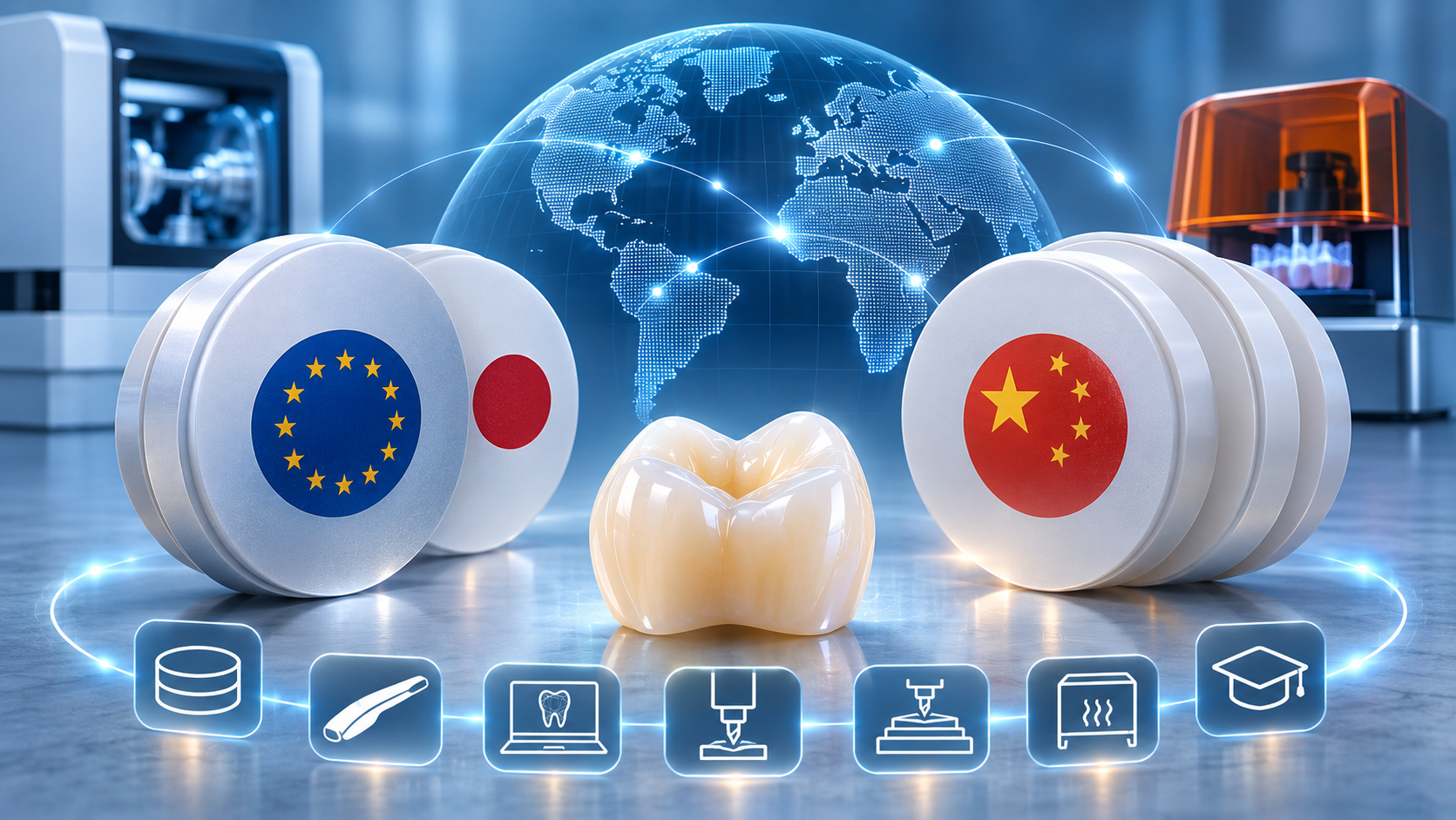
How Aidite, Yucera, Upcera, and European Manufacturers Are Competing for the Global Market
Executive Summary
For many years, the international dental zirconia market was strongly associated with European and Japanese manufacturers. Brands such as Katana, Cercon, Lava, and others established their reputations through investments in research, material development, and quality control.
However, the past decade has significantly changed this landscape. Chinese manufacturers such as Aidite, Yucera, and Upcera have expanded their international presence, developed new generations of multilayer zirconia, and begun competing in segments previously dominated by traditional brands.
This transformation goes beyond price competition. The market is beginning to value companies capable of offering not only restorative materials, but also equipment, technical support, education, and digital integration. The zirconia war is becoming a competition for comprehensive solutions.
From Traditional Leadership to Asian Expansion
Until the middle of the previous decade, Japanese and European brands held a prestigious position in the dental market. Kuraray Noritake, with its Katana line, and manufacturers such as Dentsply Sirona, Zirkonzahn, and Amann Girrbach built international recognition based on material consistency and technological development.
At that time, many Chinese products were perceived primarily as economical alternatives. However, this perception began to change as Asian manufacturers invested in industrial modernization, quality control, research, and international distribution.
The evolution of multilayer zirconia also contributed to this transformation. The development of different gradients in shade, translucency, and, in certain formulations, composition and strength expanded the commercial opportunities for these manufacturers.
This does not mean that all materials offer equivalent performance. Quality must continue to be evaluated through measurable properties, processing reliability, and scientific evidence, regardless of geographic origin or a brand's commercial positioning.
Aidite, Yucera, and Upcera: Expansion Strategies
Aidite represents one of the most evident transformations in the industry. Its activities have expanded beyond supplying zirconia discs to include CAD/CAM equipment, sintering systems, complementary materials, and solutions for different stages of laboratory production.
Yucera has also expanded its international presence, combining the evolution of its zirconia product lines with the offering of equipment and digital solutions. The expansion of distribution networks and economic competitiveness are part of its growth strategy.
Upcera, in turn, stands out for its industrial operations and the development of restorative materials, including different zirconia formulations and solutions for laboratories and manufacturing partners.
Although they have different commercial characteristics, these companies share a strategic direction: moving beyond competition based exclusively on zirconia disc prices and expanding their participation in the dental production workflow.
This shift increases competitive pressure on traditional manufacturers and offers laboratories a growing range of alternatives.
How Are Traditional Manufacturers Responding?
Japanese and European companies continue to play an important role in the development of dental zirconia.
Kuraray Noritake, for example, maintains a relevant position with its Katana line, associated with the development of different generations of materials and research into their optical and mechanical properties.
Manufacturers such as Dentsply Sirona, Zirkonzahn, and Amann Girrbach also offer materials and digital solutions developed for different restorative applications.
However, the growth of Asian competitors requires these companies to continuously justify their commercial positioning through innovation, manufacturing consistency, scientific documentation, and technical support.
Price remains important, but comparisons among manufacturers must consider other factors: batch-to-batch consistency, post-sintering accuracy, mechanical properties, optical behavior, material availability, and supply reliability.
A more expensive zirconia is not necessarily superior, just as a more economical zirconia is not necessarily inferior.
Performance must be demonstrated, not assumed based on the brand or country of manufacture.
The New Competition Involves Technology and Knowledge
The expansion of zirconia manufacturers is part of a broader transformation in digital dentistry.
Companies that previously sold only materials have begun offering milling machines, furnaces, scanners, and other equipment. At the same time, manufacturers of digital systems are seeking to integrate materials and processes into increasingly comprehensive workflows.
For laboratories, this integration may offer operational advantages, but it also requires attention to system compatibility and freedom of supplier choice.
The role of distributors is also changing. Training, technical assistance, guidance on sintering protocols, and continuing education are becoming important differentiators in a market with increasingly competitive products.
However, none of these solutions can replace the professional's technical knowledge.
The quality of a restoration depends on appropriate material selection, prosthetic design, restoration thickness, connector dimensions, the sintering protocol, and the quality of finishing and polishing.
The material provides specific properties. Knowledge makes it possible to use them correctly.
The Zirconia Market Through 2030
Current trends point toward increasingly intense international competition, with the expansion of Asian manufacturers, greater integration between materials and equipment, and continued pressure on prices.
At the same time, the evolution of multilayer zirconia is expected to continue alongside investments in automation, software, and integrated digital solutions.
This does not necessarily mean that a small group of companies will dominate the entire market. Innovation capabilities, product reliability, and freedom of integration will continue to influence purchasing decisions by dental practices and laboratories.
The main challenge for manufacturers will be to demonstrate value beyond price, while professionals will need to develop increasingly rigorous technical criteria for comparing materials and technologies.
Conclusion
The expansion of Aidite, Yucera, and Upcera demonstrates that global competition in dental zirconia has entered a new phase.
Traditional manufacturers remain relevant, but they face competitors that combine industrial capacity, competitive prices, and increasingly broad technological portfolios.
Competition is no longer limited to selling zirconia discs. It now includes digital integration, support, and technical knowledge.
KEI INSIGHT
For many years, the central question among dental laboratories was “Which is the best zirconia?” Today, that question must be accompanied by another: “Which manufacturer offers the best combination of performance, reliability, support, and technological integration?” The next decade will not necessarily be dominated by the company that produces the cheapest material or reports the highest strength values. Competitive advantage will lie in the ability to offer reliable solutions supported by technology, scientific evidence, and applied knowledge.
Next Edition — KEI 11
The Intraoral Scanner War
Member discussion
Start the conversation
Sign in to start commenting.
Sign in