

What Is Really Changing the Global Dental Industry
Executive Summary
Dentistry is undergoing one of the fastest technological transformations in its history. Artificial intelligence, intraoral scanning, additive manufacturing, new biomaterials, and integrated digital systems are changing not only the way we produce restorations, but also how we diagnose, plan treatments, and organize dental practices and laboratories.
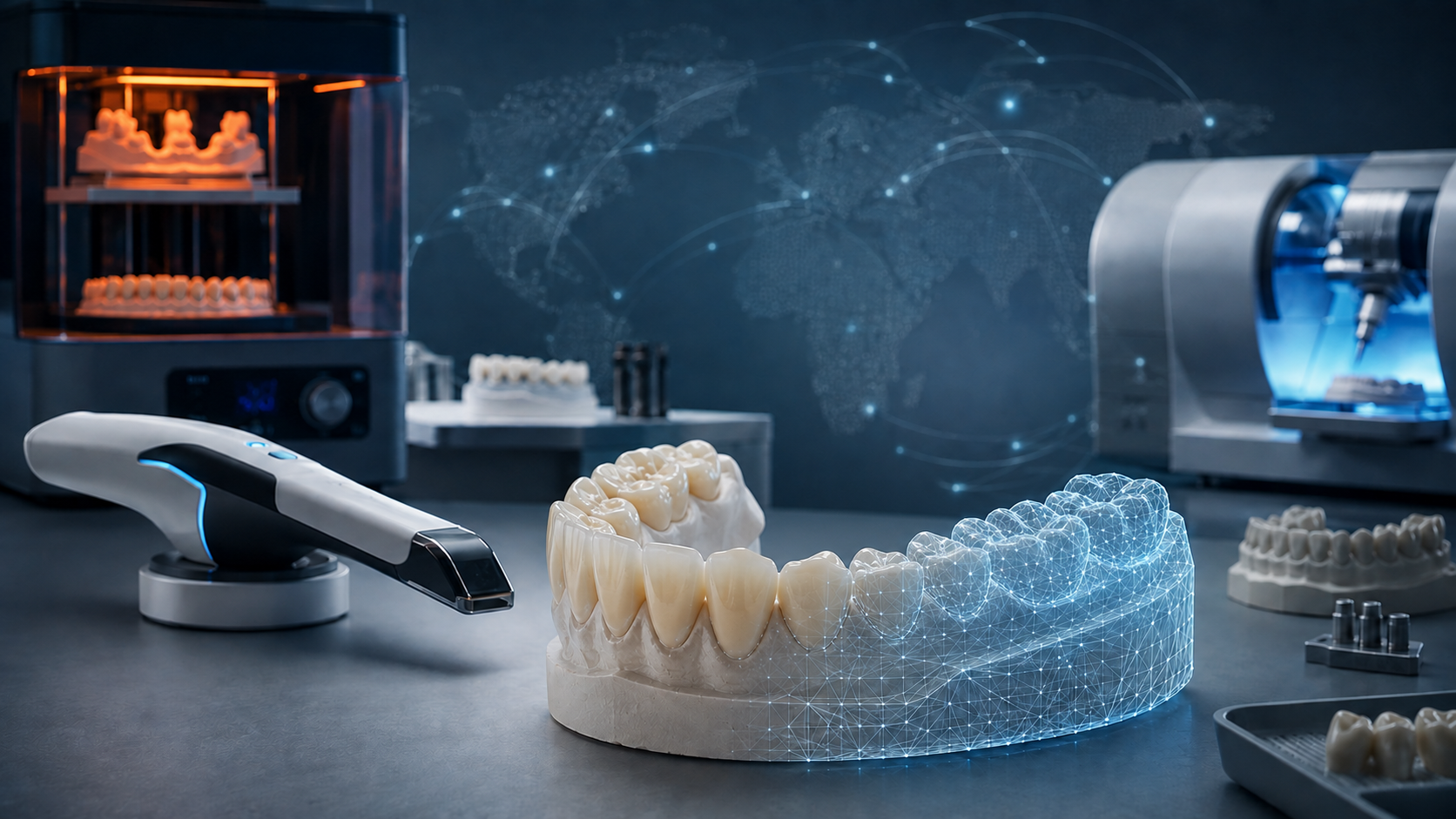
When we look at scientific publications, major international congresses, and recent movements within the industry, one trend becomes particularly clear: technologies that once evolved relatively independently are beginning to converge into a single digital ecosystem.
Scanners, CAD software, artificial intelligence, milling, 3D printing, and management systems are becoming increasingly interconnected. This integration may be more important than any individual technology considered in isolation.
Artificial Intelligence Is Becoming Fully Integrated into the Dental Workflow
Artificial intelligence has moved beyond the experimental field and is beginning to be incorporated into different stages of dental practice.
In radiology, algorithms assist in identifying and interpreting alterations in images. In orthodontics and implant dentistry, they contribute to treatment planning. In CAD/CAM systems, they are beginning to automate tasks such as anatomical structure recognition, margin definition, morphology selection, and restorative design.
For dental laboratories, this evolution is especially relevant. Processes that traditionally depended on numerous manual decisions are beginning to incorporate systems capable of automatically proposing anatomy, position, and occlusal relationships.
This does not mean the immediate disappearance of human intervention. It does, however, indicate a progressive change in its role: less repetitive execution and greater participation in supervision, validation, and complex decision-making.
The Intraoral Scanner Is No Longer Just a Premium Technology
Intraoral scanning continues to advance rapidly and is becoming increasingly integrated into the digital restorative workflow.
This evolution is not occurring only in capture quality. Scanners are becoming gateways to much larger ecosystems, connecting data acquisition, treatment planning, laboratory communication, CAD, manufacturing, and patient follow-up.
At the same time, the incorporation of artificial intelligence is likely to make these devices progressively more automated, assisting in the identification of inadequately scanned areas, structure recognition, preparation analysis, and data quality control.
As a result, the scanner is gradually moving beyond simply replacing conventional impressions and is becoming a platform for clinical data acquisition.
3D Printing: The Next Step Is Definitive Restorations
3D printing is already well established for several dental applications, such as models, surgical guides, provisional restorations, and occlusal splints. The next major challenge is to expand its use to definitive restorations.
Higher-performance resins and reinforced materials have already advanced significantly. At the same time, research involving zirconia, other ceramics, and experimental lithium-disilicate-based systems demonstrates the potential of additive manufacturing for more demanding restorative applications.
However, it is important to distinguish technological potential from clinical maturity.
Ceramic printing still faces challenges related to accuracy, processing shrinkage, internal defects, surface finishing, optical properties, and repeatability. Therefore, milling continues to hold a central position in the production of definitive ceramic restorations.
The technological direction, however, is clear: additive manufacturing is advancing toward applications that previously belonged almost exclusively to subtractive manufacturing.
The Laboratory of the Future Will Be Hybrid
This evolution makes a strict division between a “milling laboratory” and a “3D printing laboratory” increasingly unlikely.
The model that is beginning to consolidate is hybrid.
Certain structures will continue to be more appropriately milled, while others may be produced through 3D printing. The decision will depend on the material, geometry, clinical indication, cost, and production efficiency.
In this scenario, scanners, CAD, milling, 3D printing, and artificial intelligence become part of the same workflow.
The most advanced digital laboratory, therefore, will probably not be the one that chooses a single technology, but the one that knows how to combine different technologies efficiently and predictably.
Materials Are Changing Too
The transformation is not occurring only in equipment.
In zirconia, we are seeing the evolution of multilayer structures and property gradients, with the goal of balancing strength and optical behavior within the same restoration.
In polymer-based and hybrid restorative materials, new formulations aim to improve mechanical properties, stability, and clinical behavior.
Another important line of research involves so-called bioactive or functionalized materials, developed to establish more complex interactions with the oral environment, including ion release and strategies designed to reduce bacterial activity or promote remineralization processes.
Here, caution is also necessary: bioactivity demonstrated experimentally does not automatically mean proven long-term clinical benefit. The scientific evolution of these materials should be followed closely over the coming years.
Emerging Technologies: Digitization Without a Scanner?
Some of the most interesting research in 2026 points toward even more disruptive possibilities.
Research groups have been investigating three-dimensional reconstruction of dental structures using intraoral photographs or information obtained from two-dimensional images combined with artificial intelligence.
These technologies are still far from replacing intraoral scanners in high-precision restorative workflows. However, they demonstrate an interesting direction: in the future, three-dimensional reconstruction may depend less on specific equipment and more on the ability of algorithms to interpret different data sources.
If these approaches achieve clinically adequate accuracy, they may reduce costs and expand access to digital dentistry, especially in regions where intraoral scanners still represent a significant investment.
Artificial Intelligence Is Also Coming to the Smartphone
Another relevant development is the creation of artificial intelligence models capable of interpreting dental images directly on mobile devices.
Potential applications include screening, remote follow-up, education, and teledentistry.
Once again, this is an emerging technology that must be distinguished from clinically validated diagnostic systems. However, its strategic importance is clear.
The smartphone may become an increasingly important interface between the patient, the professional, and artificial intelligence systems.
Dentistry Is Beginning to Extend Beyond the Dental Practice
For decades, much of the information related to dental care was obtained exclusively during the appointment.
Digitalization is beginning to change this model.
Photographs, applications, remote monitoring systems, and connected platforms make it possible to envision a form of dentistry in which part of the monitoring process takes place between appointments.
This may expand the role of prevention and allow certain changes to be identified or monitored earlier.
The dental practice will remain fundamental, but the digital relationship between professional and patient is likely to extend beyond the moment of the consultation.
What Does This Mean for Dentists and Dental Technicians?
The most important consequence of this transformation may not be learning how to operate every new piece of equipment.
Specific technologies change rapidly. Software is updated, equipment is replaced, and new systems appear continuously.
The most important knowledge will be understanding how to integrate science, technology, and clinical decision-making.
For the dentist, this means mastering clinical fundamentals while understanding the possibilities and limitations of new digital tools.
For the dental technician, it means a progressive transition from certain manual tasks toward higher-complexity activities: process control, material selection, design validation, esthetic characterization, and management of different manufacturing technologies.
A New Competition Is Also Beginning in the Industry
Competition among dental companies is increasingly likely to move beyond the isolated sale of materials or equipment.
A scanner connected to software, which communicates with CAD, sends information to production systems, and uses artificial intelligence creates a much broader ecosystem than an individual product.
For this reason, software, integration, cloud-based systems, artificial intelligence, education, and technological support are becoming strategic components of the dental industry.
Value is beginning to shift from the individual product to the ecosystem that connects products, data, and knowledge.
What Should We Watch Over the Next 24 Months?
Some developments are already clearly underway: greater integration of artificial intelligence into scanners and CAD systems, growth of 3D printing for definitive applications, expansion of cloud-based workflows, and increased automation in laboratory processes.
Others remain at a more experimental stage, but deserve close attention: clinical-scale printing of definitive ceramic restorations, three-dimensional reconstruction without conventional scanners, and multimodal artificial intelligence systems capable of simultaneously assisting in diagnosis, treatment planning, and patient follow-up.
The central question is not to determine which of these technologies will replace the current ones.
It is to understand which of them will be able to demonstrate sufficient accuracy, efficiency, safety, and clinical benefit to become part of routine dental practice.
KEI INSIGHT
Perhaps the greatest transformation in dentistry is not simply technological.
It is the speed at which knowledge is changing.
Never before have we had access to so many materials, devices, software systems, studies, and sources of information. The challenge is no longer simply to find information, but to interpret it critically, separate evidence from marketing, and transform innovation into clinically applicable protocols.
Between 2026 and 2030, new technologies will certainly emerge. Some will transform dentistry. Others will disappear after the initial enthusiasm.
For this reason, the true differential will not simply be using the latest technology.
It will be understanding which technologies truly improve our decisions and our outcomes.
Next Edition — KEI 2
Trends, International Events, and Technologies Shaping the Future of Dentistry
Which technological and economic movements are redefining the future of digital dentistry?
Member discussion
Start the conversation
Sign in to start commenting.
Sign in