

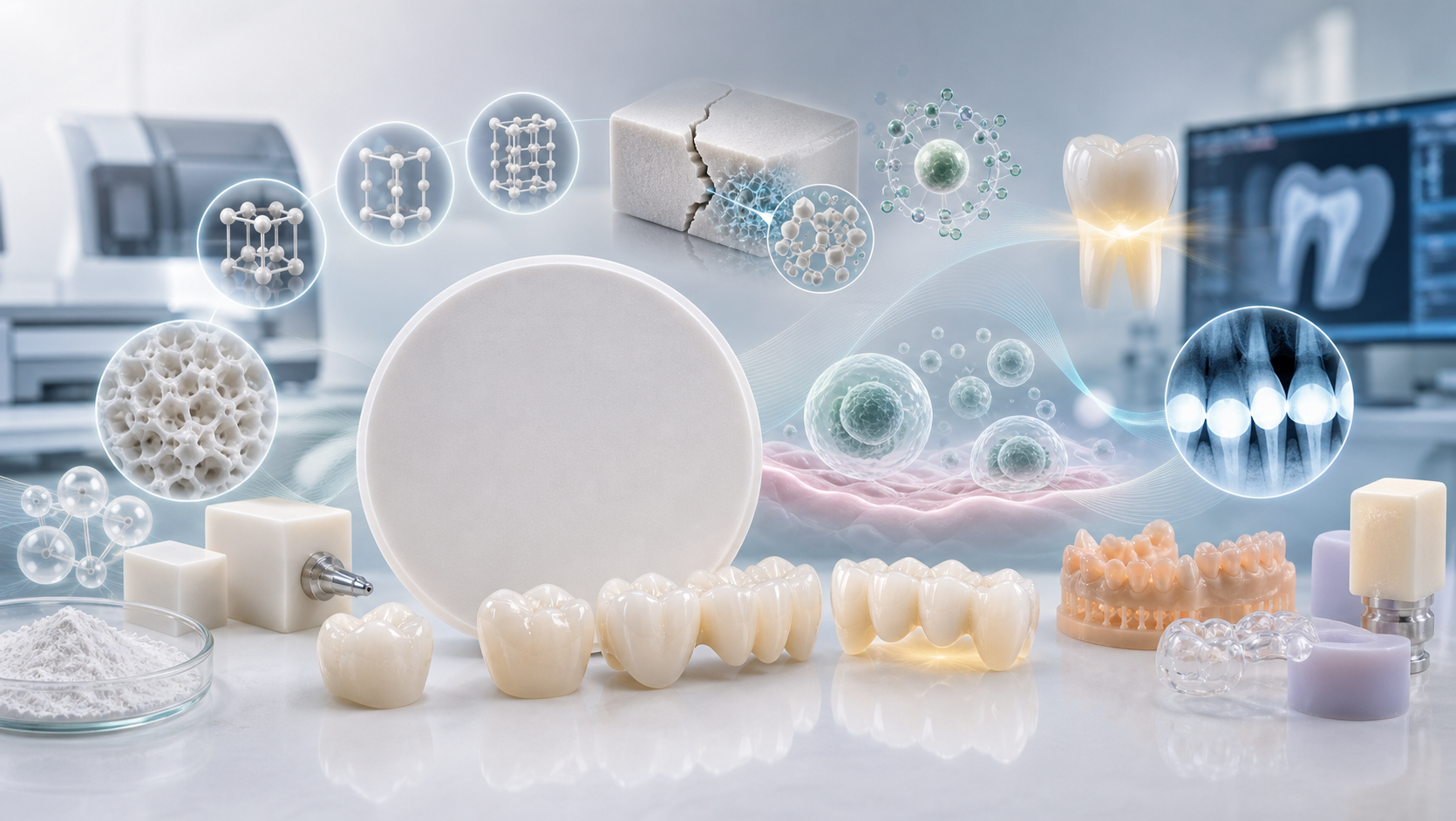
Fundamentals of Zirconia
Understanding the Material That Transformed Restorative Dentistry
To truly understand why zirconia has become one of the most influential materials in modern restorative dentistry, it is necessary to go beyond its clinical indications and deepen our knowledge of its structure, composition, and scientific behavior.
Despite its widespread use in crowns, extensive prostheses, implants, and complex rehabilitations, many professionals still know zirconia mainly through its clinical performance, without fully understanding the mechanisms that explain its strength, stability, and limitations.
It is precisely this knowledge that distinguishes the simple use of a material from its evidence-based application.
What You Will Find in This Module
01 - Zirconia Is Not a Metal
Understanding the true ceramic nature of zirconia and why it behaves differently from traditional metals.
02 - Crystalline Phases of Zirconia
How the monoclinic, tetragonal, and cubic phases influence the properties of the material.
03 - The Importance of Transformation Toughening
The mechanism responsible for making zirconia one of the strongest ceramics in dentistry.
04 - Yttria and Mechanical Strength
How yttria concentration affects translucency, strength, and clinical behavior.
05 - 6Y and Ultra-Translucent Zirconia
What really changes when the cubic-phase content is increased.
06 - Zirconia and Biocompatibility
Why zirconia is considered one of the most biocompatible materials in modern dentistry.
07 - Radiopacity of Zirconia
The clinical importance of radiopacity in diagnosis and restorative follow-up.
08 - Zirconia and Thermal Conductivity
How low thermal conductivity influences comfort, biology, and long-term clinical performance.
09 - The End of the One-Zirconia Era
The evolution of different generations of zirconia and the emergence of materials developed for specific clinical indications.
10 - The Clinical Evolution of Translucent Zirconias, Lithium Disilicate, and Hybrid CAD/CAM Materials
The advancement of biomaterials has not only expanded the number of available options, but has also profoundly changed the way treatments are planned, indicated, and performed.
Why Is This Knowledge Important?
A large part of the clinical and laboratory decisions related to zirconia depends directly on understanding concepts such as:
- Crystalline structure;
- Yttria stabilization;
- Fracture strength;
- Fracture toughness;
- Translucency;
- Biocompatibility;
- Optical behavior;
- Long-term stability.
Without this knowledge, it becomes difficult to correctly interpret the technical information provided by manufacturers or to understand the real differences among the various categories of zirconia currently available on the market.
Kiwid Education Insight
Zirconia revolutionized restorative dentistry not only because of its strength or esthetics. Its true differential lies in the unique combination of materials science, ceramic engineering, and clinical application.
Understanding these fundamentals allows clinicians and technicians to interpret the scientific literature more critically, select materials with greater confidence, and make more predictable restorative decisions.
This is exactly the journey we will begin in the next article.
Next Article
01 - Zirconia Is Not a Metal
Although it is often compared with metals used in dentistry, zirconia belongs to a completely different category of materials.
But after all:
Why is zirconia not considered a metal?
The answer to this question will be the first step toward understanding the structure and behavior of one of the most important materials in modern dentistry.
Member discussion
Start the conversation
Sign in to start commenting.
Sign in