

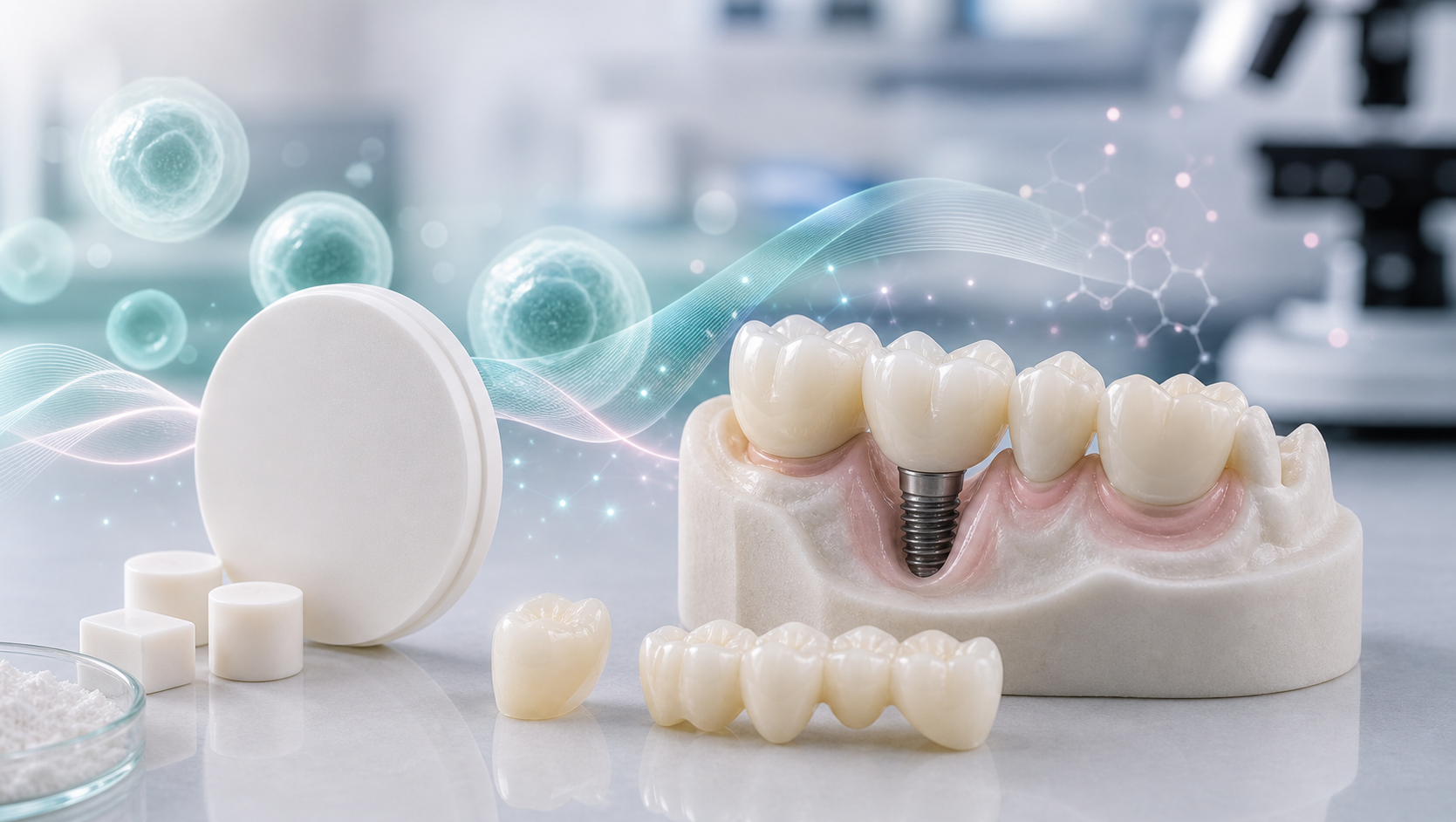
Why Does This Material Exhibit Excellent Behavior in Soft and Hard Tissues?
Central Question
Why has zirconia come to be considered one of the most biocompatible materials in modern dentistry?
The answer goes far beyond esthetics. Although its light color and its ability to reproduce the natural appearance of teeth have contributed to its popularity, the true differential of zirconia lies in the way it interacts with biological tissues.
Over the past decades, clinical and laboratory studies have demonstrated that zirconia exhibits excellent compatibility with both soft and hard tissues, favoring peri-implant health and tissue stability over time.
This interaction involves several biological factors, including gingival response, bone tissue behavior, bacterial adhesion, biofilm formation, and the immune system response to the material.
Understanding these mechanisms helps explain why zirconia has gained a prominent position not only as a restorative material, but also as a biologically favorable alternative for prosthetic components and implant-supported applications.
Introduction
Over the past decades, zirconia has become one of the most extensively studied materials in restorative dentistry. Initially, scientific interest focused on its high mechanical strength and its ability to replace metallic frameworks in a variety of clinical applications.
As research progressed, however, another characteristic began to receive considerable attention: its excellent biocompatibility. Studies have shown that zirconia exhibits a highly favorable interaction with biological tissues, contributing to the stability of both soft and hard tissues and to the maintenance of peri-implant health.
For this reason, its use has expanded far beyond conventional crowns and prostheses, and now includes prosthetic abutments, ceramic implants, transmucosal components, and rehabilitations that require high biological and esthetic performance.
What Is Biocompatibility?
Biocompatibility is the ability of a material to remain in contact with biological tissues without causing significant adverse effects, allowing a stable and predictable interaction over time.
In dentistry, a biocompatible material should be able to coexist with oral tissues without triggering undesirable inflammatory responses, cellular toxicity, or impairment of the health of adjacent tissues.
In general, a biocompatible material should exhibit:
- Low cellular toxicity;
- Absence of significant inflammatory reactions;
- Good compatibility with soft and hard tissues;
- Chemical stability in the oral environment;
- Low tendency for bacterial biofilm accumulation;
- Ability to maintain tissue health over the long term.
These characteristics are fundamental to the clinical success of restorations and help explain why zirconia has become one of the most valued options in contemporary dentistry.
Why Is Zirconia Biocompatible?
The excellent biocompatibility of zirconia is directly related to its ceramic nature and the high stability of its chemical structure. Unlike some metallic materials, zirconia exhibits extremely stable behavior when exposed to the oral environment.
Its microstructure provides characteristics that favor a highly predictable biological interaction, including:
- High chemical resistance;
- Low solubility in the oral environment;
- Absence of corrosion;
- Excellent surface stability.
As a consequence, zirconia releases minimal amounts of substances into the adjacent tissues and maintains its properties over time. This stability reduces the potential for undesirable biological reactions and contributes to the maintenance of the health of the soft and hard tissues that remain in contact with the material.
Absence of Corrosion
One of the most important characteristics of zirconia is its high chemical stability. Unlike metals, it is not subject to electrochemical corrosion when exposed to the oral environment, even after long periods of clinical function.
This stability provides important biological advantages, since the material:
- Does not release metallic ions into adjacent tissues;
- Does not undergo significant chemical degradation over time;
- Maintains its surface properties in a stable manner.
As a consequence, zirconia exhibits excellent biological predictability and reduces the risk of changes related to corrosion, contributing to the maintenance of peri-implant tissue health and to the longevity of restorations and prosthetic components.
Interaction with Soft Tissues
Several studies have demonstrated that zirconia exhibits a highly favorable interaction with gingival tissues. Its stable and biocompatible surface contributes to a predictable tissue response, both in dental restorations and in implant-supported components.
Clinically, the following are frequently observed:
- Low levels of gingival inflammation;
- Good adaptation of the soft tissues;
- Excellent peri-implant stability;
- Lower tendency for bacterial biofilm accumulation.
These characteristics favor the maintenance of gingival health and help preserve tissue stability over time. As a result, zirconia has become a widely used option in situations in which biological integration and soft-tissue stability are decisive factors for treatment success.
Zirconia and Bacterial Biofilm
One of the most important findings in recent years is related to the influence of material surfaces on bacterial adhesion. Several studies demonstrate that properly polished and well-finished zirconia surfaces may exhibit lower biofilm accumulation when compared with various other restorative materials.
This characteristic is associated with the high surface stability of zirconia and the quality of the finish achieved after laboratory and clinical procedures.
However, it is important to understand that this does not mean the absence of bacterial plaque or immunity to microbial colonization. No restorative material is capable of completely preventing biofilm formation.
What the studies suggest is a lower tendency for bacterial adhesion and colonization, especially when the surface exhibits low roughness and receives an adequate finish. This characteristic may contribute to the maintenance of gingival and peri-implant health, reinforcing one of the main biological advantages of zirconia.
The Role of Surface Finishing
The biocompatibility of a restoration does not depend exclusively on the material used. Surface quality plays a fundamental role in the way tissues and microorganisms interact with the material over time.
Rough, poorly polished, or contaminated surfaces tend to favor greater bacterial retention and biofilm accumulation, increasing the risk of inflammation of the adjacent tissues.
For this reason, surface finishing should be regarded as an integral part of treatment. A properly polished and decontaminated surface not only improves the biological behavior of the restoration, but also contributes to the long-term maintenance of gingival and peri-implant health.
In other words, the biological excellence of zirconia depends both on the properties of the material and on the quality of the clinical and laboratory protocol used during its finishing.
Zirconia and Peri-Implant Health
The use of zirconia abutments has increased significantly in recent years, driven not only by esthetic considerations, but also by the favorable biological outcomes observed around peri-implant tissues.
Several studies report important benefits associated with the use of these components, including:
- Excellent soft-tissue response;
- Greater esthetic stability over time;
- Reduced risk of grayish shine-through in thin tissues;
- Good maintenance of the peri-implant gingival profile.
These characteristics are especially relevant in the anterior region, where small changes in the tissues can compromise the final esthetic result.
For this reason, zirconia has become established as an important alternative to metallic abutments, combining favorable biological integration, soft-tissue stability, and excellent esthetic performance.
The Biological Esthetic Aspect
In addition to its excellent biocompatibility, zirconia offers an important esthetic advantage related to the interaction between the restoration and the peri-implant tissues.
Because it has a light color and high optical stability, zirconia reduces the risk of darkening of the soft tissues and minimizes undesirable effects that may compromise the final esthetic outcome. Among the most frequently observed benefits are:
- Lower risk of gingival shadowing;
- Reduced grayish reflections;
- Better esthetic integration in thin tissues.
This effect becomes especially relevant in the anterior region, where small changes in tissue color can significantly compromise the natural appearance of the smile.
For this reason, zirconia has become widely used in prosthetic components and restorations located in areas of high esthetic demand, predictably combining biological performance and visual integration.
Integration with Bone
In addition to its excellent interaction with soft tissues, zirconia also exhibits highly favorable behavior in contact with bone tissue. Experimental and clinical studies demonstrate that the material is capable of establishing stable biological integration, favoring tissue maintenance over time.
Scientific evidence shows consistent results related to:
- Good osseointegration;
- High biological stability;
- Tissue response comparable to that observed with titanium implants.
These characteristics contributed to the development of modern ceramic zirconia implants, which emerged as an alternative to metallic implants in situations in which biological and esthetic factors assume particular importance.
Although titanium remains the reference standard in implant dentistry, zirconia has demonstrated the potential to provide predictable bone integration associated with the esthetic and biological advantages characteristic of ceramic materials.
Is There Rejection to Zirconia?
True immunological rejection of zirconia is extremely rare. According to the available scientific literature, the material exhibits excellent biological tolerance and a highly favorable history of interaction with soft and hard tissues.
In most cases, when clinical complications occur around zirconia restorations or components, the cause is not related to the material itself, but rather to other factors that influence peri-implant health and treatment longevity.
Among the factors most frequently associated with complications are:
- Inadequate oral hygiene;
- Bacterial biofilm accumulation;
- Functional overload;
- Prosthetic problems;
- Local clinical and biological factors.
For this reason, clinical success does not depend only on the biocompatibility of the material, but on the proper integration of planning, clinical execution, maintenance, and control of risk factors.
Zirconia provides a highly favorable biological foundation, but it still depends on the same principles that determine the success of any dental treatment.
Comparison with Other Materials
| Characteristic | Zirconia | Titanium |
|---|---|---|
| Biocompatibility | Excellent | Excellent |
| Corrosion | No | Very low |
| Color | White | Metallic gray |
| Gingival esthetics | Superior | Good |
| Osseointegration | Excellent | Excellent |
| Bacterial accumulation | Low | Low |
The Importance of Cleaning and Decontamination
Although zirconia exhibits excellent biocompatibility, its surface may become contaminated during clinical and laboratory procedures. Substances such as saliva, blood, and phosphate-rich compounds can adhere to the material surface and negatively interfere with its performance.
This contamination may compromise adhesion to resin cements, influence interaction with peri-implant tissues, and affect the clinical predictability of the treatment.
For this reason, the biocompatibility of zirconia must be accompanied by appropriate cleaning and decontamination protocols. Proper surface preparation remains a fundamental step in ensuring the maximum biological and adhesive performance of the material.
In other words, a clean and properly decontaminated zirconia surface is just as important as the choice of the material itself for long-term clinical success.
Clinical Translation
The excellent biocompatibility of zirconia does not mean that the material is capable of compensating for failures in diagnosis, planning, or clinical execution.
Although its biological properties are highly favorable, restorative success still depends on fundamental principles of dentistry.
Factors such as correct diagnosis, appropriate planning, occlusal control, effective oral hygiene, and periodic maintenance remain decisive for treatment longevity.
However, when these principles are respected, zirconia provides an extremely favorable biological foundation, contributing to peri-implant tissue stability, maintenance of gingival health, and long-term clinical predictability.
In other words, zirconia does not replace good dentistry, but it provides a biological environment that favors its success.
Conclusion
The combination of chemical stability, absence of corrosion, excellent soft-tissue response, and low tendency for bacterial retention has made zirconia one of the most biocompatible materials currently available in dentistry.
These characteristics help explain its increasing use not only in crowns and prostheses, but also in prosthetic abutments, transmucosal components, and even ceramic implants.
Over the years, scientific evidence has demonstrated that zirconia exhibits a highly favorable interaction with peri-implant tissues, contributing to the maintenance of biological health and tissue stability.
More than a strong and esthetic material, zirconia has become established as a biologically predictable solution, capable of combining mechanical performance, tissue integration, and clinical longevity while meeting the demands of contemporary dentistry.
Kiwid Education Insight
The success of a restoration does not depend only on its mechanical strength.
It must also coexist harmoniously with biological tissues for many years.
The true strength of zirconia lies not only in its resistance to fracture, but in its ability to combine biomechanics, esthetics, and biology in a single restorative material.
Next Article
07 - Radiopacity of Zirconia
The radiographic interpretation of zirconia restorations is a fundamental aspect of modern clinical practice.
Its high radiopacity facilitates visualization of restoration margins, internal adaptation, and the relationship with adjacent dental structures.
References for this article
1 . Andreiotelli M, Wenz HJ, Kohal RJ. Are ceramic implants a viable alternative to titanium implants? A systematic literature review. Clinical Oral Implants Research. 2009;20(Suppl 4):32–47. doi:10.1111/j.1600-0501.2009.01785.x.
- van Brakel R, Meijer GJ, Verhoeven JW, Jansen J, de Putter C, Cune MS. Soft tissue response to zirconia and titanium implant abutments: an in vivo within-subject comparison. Journal of Clinical Periodontology. 2012;39(10):995–1001. doi:10.1111/j.1600-051X.2012.01931.x.1
Member discussion
Start the conversation
Sign in to start commenting.
Sign in