

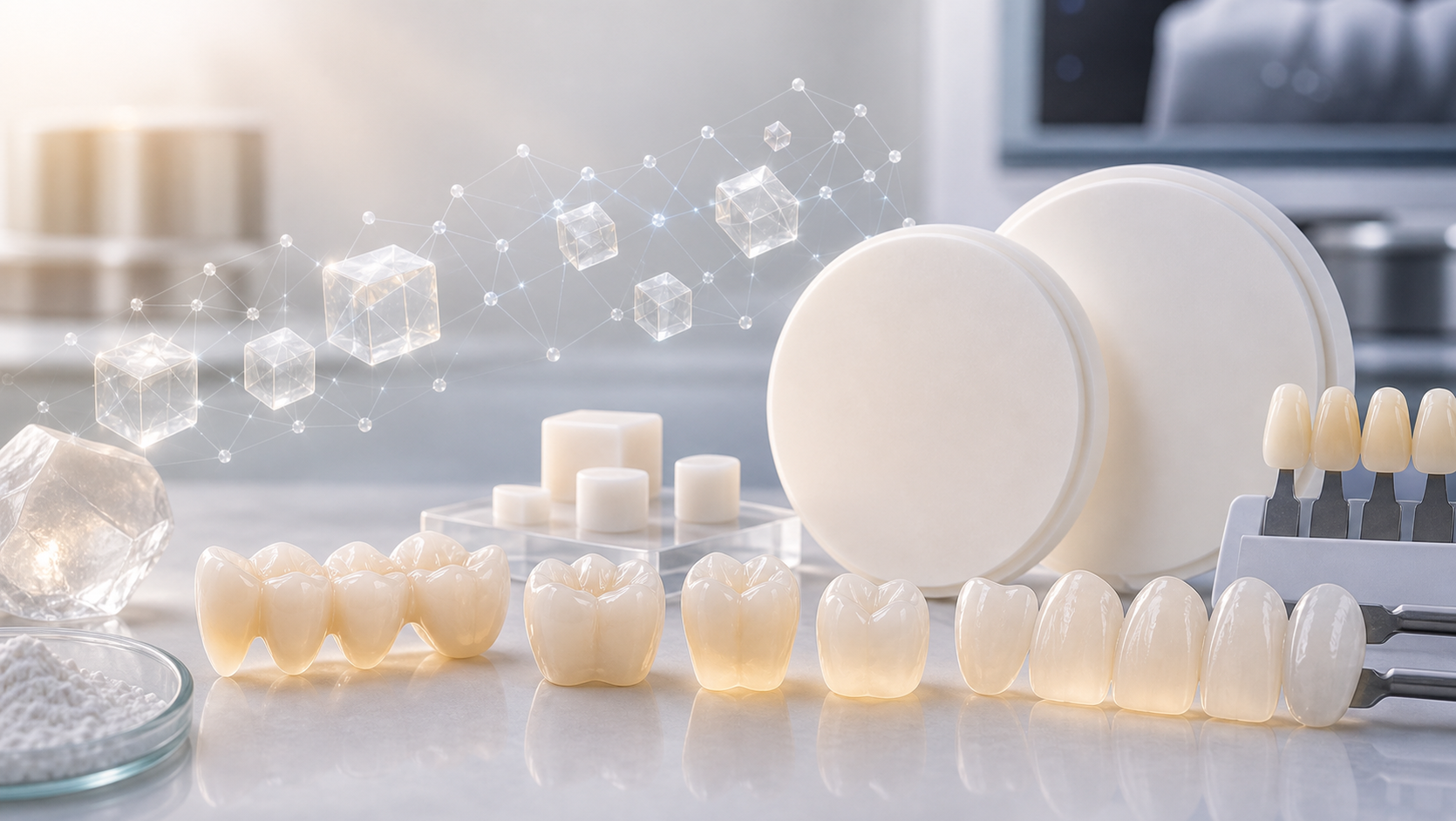
6Y Zirconia: Translucency and Biomechanical Limitations
How Far Can We Enhance Esthetics Without Compromising Performance?
Central Question
If increasing yttria content can improve translucency, why not continue increasing its concentration indefinitely?
The evolution of dental zirconia involves the pursuit of more natural optical properties while preserving mechanical properties compatible with restorative applications. However, modifying the composition to enhance light transmission may also alter resistance to crack propagation.
In this context, formulations containing approximately 6 mol% yttria, known as 6Y, have emerged. They expand the possibilities for improving zirconia's optical properties but require an understanding of the trade-off among translucency, strength, and toughness.
Increasing yttria content changes the balance among properties; it does not, by itself, represent an improvement in every aspect of the material.
What Characterizes 6Y Zirconia?
The designation 6Y indicates a formulation containing approximately 6 mol% yttrium oxide (Y₂O₃). This value represents a molar percentage and should not be confused with a percentage by weight.
Yttria modifies the stability of crystalline phases. As its concentration increases, the proportion of tetragonal grains capable of transforming into the monoclinic phase under stress tends to decrease. Consequently, the contribution of the transformation toughening mechanism is reduced.
This mechanism helps hinder crack propagation in conventional zirconias. Its reduced contribution partly explains the decrease in fracture toughness observed in more highly stabilized formulations.
However, yttria content alone does not fully characterize the material. The distribution of this stabilizer, additives, grain size, porosity, and sintering also influence its properties.
Why Can Translucency Increase?
Light transmission depends on interactions between light and the microstructure. Pores, pigments, inclusions, and differences in crystal orientation or refractive index may contribute to light scattering.
Increasing yttria content changes the distribution and characteristics of the crystalline phases, potentially reducing some of this scattering. The explanation "more yttria, more cubic phase, greater translucency" is useful as an introduction, but it does not represent the full complexity of modern formulations.
Restoration thickness, shade, surface finish, and densification also contribute to the final result. Therefore, it should not be assumed that every 6Y zirconia will necessarily be more translucent than every 5Y zirconia without comparing the products under the same conditions.
Furthermore, greater translucency does not automatically mean better esthetics. A material that transmits more light may have a reduced ability to mask discolored substrates, making the final outcome dependent on the entire restorative system.
The Trade-Off with Fracture Toughness
Fracture toughness describes a material's resistance to crack propagation. It differs from flexural strength, which also depends on existing defects and testing conditions.
When the contribution of transformation toughening decreases, zirconia tends to exhibit lower defect tolerance. This characteristic becomes particularly relevant in the presence of reduced thickness, small connectors, surface damage, or demanding functional conditions.
Studies investigating zirconias with different yttria contents demonstrate this trade-off between optical properties and fracture resistance. However, the results must be interpreted for each formulation, without treating nominal composition as an exact predictor of performance.
| Formulation | Optical Trend | Contribution of Transformation Toughening |
|---|---|---|
| 3Y-TZP | Relatively lower translucency | More pronounced |
| 4Y-PSZ | Intermediate translucency | Reduced compared with 3Y |
| 5Y-PSZ | Relatively higher translucency | More limited |
| 6Y | Formulation designed for high translucency | Generally even more limited |
Educational comparison. Actual properties depend on the product, processing conditions, and evaluation methods.
"Ultra Translucent" Does Not Necessarily Mean 6Y
Terms such as High Translucent, Super Translucent, and Ultra Translucent are commercially used to describe optical characteristics or differentiate product lines. They do not uniformly identify a specific chemical composition.
Therefore, a zirconia marketed as "ultra-translucent" should not automatically be classified as 6Y. It is necessary to consult the declared composition, reported properties, and specific indications.
The same attention applies to multilayer discs. Some primarily exhibit shade transitions, while others combine regions with different yttria contents and mechanical properties. In products with compositional gradients, the vertical positioning of the restoration during nesting may influence which regions of the material form structurally important areas.
Therefore, treatment planning must consider the distribution of properties throughout the disc, in addition to the desired shade outcome.
How Should Clinical Indications Be Interpreted?
A 6Y formulation may be considered when its documented properties and indications are compatible with the restorative requirements. Selection requires evaluating available thickness, support, geometry, prosthesis span, occlusion, and esthetic demands.
An anterior location alone does not guarantee favorable biomechanical conditions. Likewise, high translucency does not justify reducing thickness or transferring indications from a zirconia with higher fracture toughness.
It is also inappropriate to consider 6Y zirconia and lithium disilicate equivalent materials. 6Y remains a zirconia-based polycrystalline ceramic, whereas lithium disilicate is a glass ceramic with a different microstructure and different surface treatment strategies.
Clinical comparisons should consider the complete set of properties and the available evidence for each product. Favorable laboratory results alone do not demonstrate equivalent clinical longevity.
Clinical Implications
3Y, 4Y, 5Y, and 6Y represent different possibilities within the zirconia family. Increasing yttria content expands certain optical possibilities but may reduce the contribution of important mechanisms that resist crack propagation.
Material selection should begin with the restoration's requirements and the documented characteristics of the material, avoiding the use of compositional classifications as a quality ranking.
Conclusion
6Y formulations demonstrate how composition can be modified to enhance zirconia translucency. This development also changes its mechanical behavior and requires specific selection criteria.
The clinical objective is to achieve an appropriate combination of optical integration, fracture resistance, and conditions of use.
Kiwid Education Insight
Understanding the evolution of zirconia means recognizing different balances among material properties. Selection becomes more informed when professionals identify the optical and mechanical behavior required for a particular restoration and choose a material capable of meeting those requirements.
Next Article
06 — Zirconia and Biocompatibility
Which characteristics help explain how zirconia interacts with biological tissues?
In the next article, we will explore how composition, chemical stability, and surface conditions influence tissue responses and the application of zirconia in dental prosthetics and implant dentistry.
References for this article
- Cesar PF, Miranda RBP, Santos KF, Scherrer SS, Zhang Y. Recent advances in dental zirconia: 15 years of material and processing evolution. Dental Materials. 2024;40(5):824–836. doi:10.1016/j.dental.2024.02.026.
- Yousry M, Hammad I, El Halawani M, Aboushelib M. Translucency of recent zirconia materials and material-related variables affecting their translucency: a systematic review and meta-analysis. BMC Oral Health. 2024;24(1):309. doi:10.1186/s12903-024-04070-7. A revisão identifica explicitamente a 6Y-PSZ como geração ultratranslúcida.
- Uwanyuze RS, Ramesh S, Lwin N, et al. Mechanical properties, translucency, and low temperature degradation (LTD) of yttria (3–6 mol%) stabilized zirconia. Ceramics International. 2021;47(11):15868–15874. doi:10.1016/j.ceramint.2021.02.161.
- Čokić SM, Cóndor M, Vleugels J, Van Meerbeek B, Van Oosterwyck H, Inokoshi M, Zhang F. Mechanical properties–translucency–microstructure relationships in commercial monolayer and multilayer monolithic zirconia ceramics. Dental Materials. 2022;38(5):797–810. doi:10.1016/j.dental.2022.04.011.
- Zhang F, Reveron H, Spies BC, Van Meerbeek B, Chevalier J. Trade-off between fracture resistance and translucency of zirconia and lithium-disilicate glass ceramics for monolithic restorations. Acta Biomaterialia. 2019;91:24–34. doi:10.1016/j.actbio.2019.04.043.
Member discussion
Start the conversation
Sign in to start commenting.
Sign in