

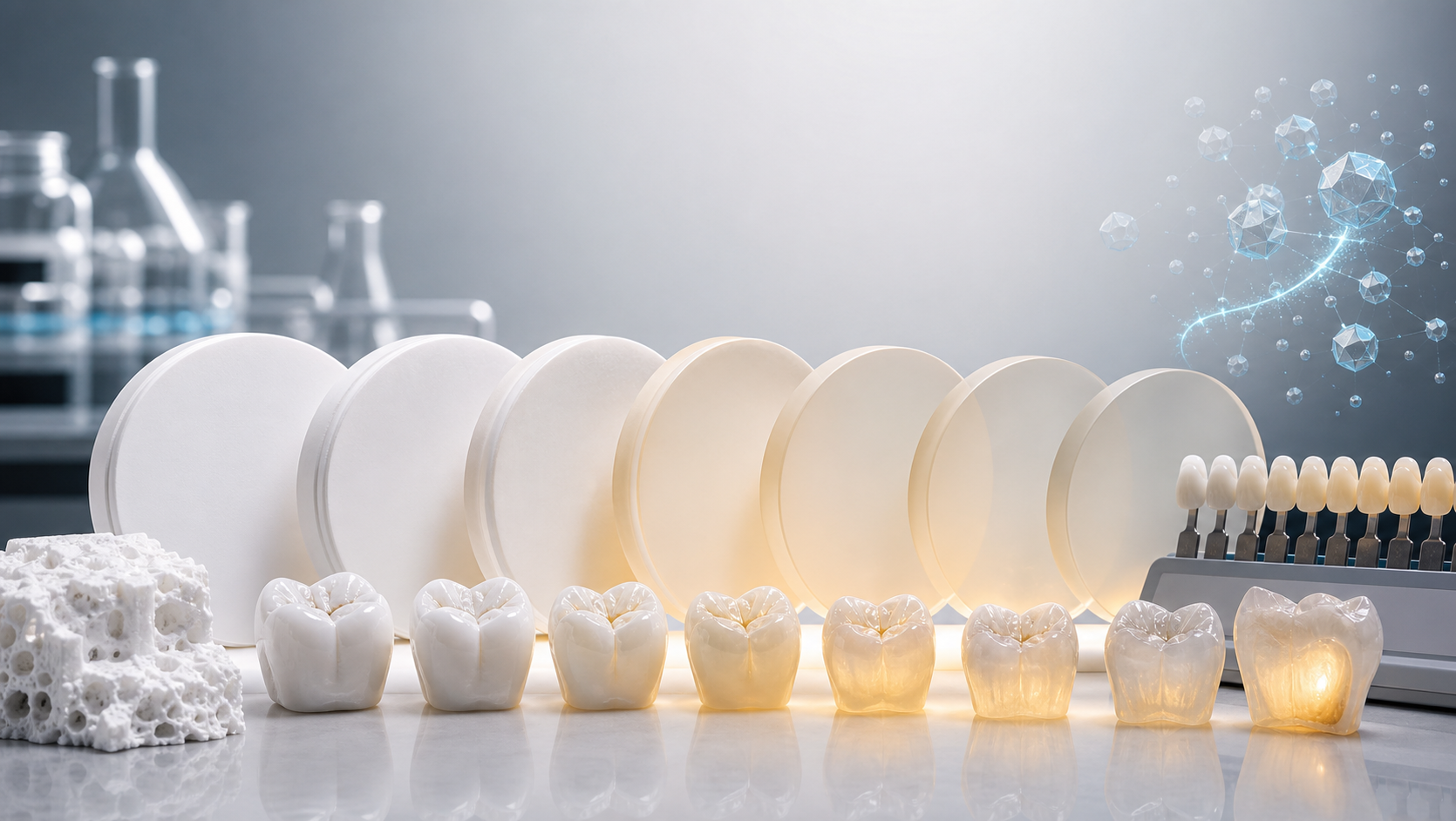
How Yttria Content Transformed the Evolution of Dental Zirconias
Central Question
How was a small increase in the concentration of yttrium oxide (Y₂O₃) able to completely transform the evolution of dental zirconias, creating materials with different levels of strength, translucency, and clinical indications?
Introduction
The evolution of dental zirconias did not occur by chance. It was the result of increasingly precise control of the chemical composition of the material, especially the amount of yttrium oxide (Y₂O₃) added during manufacturing.
In the previous chapters, we saw that the properties of zirconia depend directly on the proportion of its crystalline phases and that the tetragonal phase is responsible for the mechanism of Transformation Toughening, which is responsible for its high mechanical strength.
However, the industry realized that it was possible to modify this microstructure simply by adjusting the amount of yttria incorporated into the material.
This control made it possible to create successive generations of zirconia, each developed to meet different clinical needs, ranging from maximum strength to high translucency.
The Role of Yttria
Pure zirconia has limited stability for dental applications.
For this reason, yttrium oxide (Y₂O₃) is added, with the main function of stabilizing specific crystalline phases and controlling the behavior of the microstructure.
As the yttria concentration increases, part of the originally tetragonal crystals begins to exhibit a cubic structure, increasing the fraction of the cubic phase in the zirconia microstructure. This change significantly modifies the optical behavior of the material and was one of the main factors responsible for the development of the more translucent generations of zirconia currently available.
The Evolution of Zirconia Generations
For many years, the priority was to develop materials capable of withstanding high masticatory loads.
The first dental zirconias contained approximately 3 mol% yttria (3Y-TZP), with a predominance of the tetragonal phase and excellent mechanical strength.
As the demand for more esthetic restorations increased, the industry began to gradually increase the yttria content.
As a consequence, 4Y-PSZ zirconias emerged, followed by 5Y-PSZ zirconias, offering progressively higher levels of translucency and optical behavior increasingly similar to that of glass ceramics.
More recently, multilayer zirconias were developed, representing the combination of these different compositions within a single disc.
The Principle That Explains the Entire Evolution
The entire evolution of modern zirconias can be summarized in a very simple sequence:
More yttria → greater cubic-phase fraction → greater light transmission → greater translucency.
However, this optical gain is accompanied by an inevitable consequence:
Lower tetragonal-phase content → lower Transformation Toughening potential → progressive reduction in mechanical strength.
This balance between strength and esthetics has become the main challenge in the development of the most recent generations of zirconia.
Far Beyond Strength
The goal of the industry is no longer simply to manufacture the strongest zirconia.
Beginning with the 4Y and 5Y generations, the focus shifted toward developing materials capable of offering different combinations of:
- mechanical strength;
- translucency;
- optical behavior;
- clinical indication.
In this way, each generation began to meet specific restorative needs.
The Revolution of Multilayer Zirconias
The most recent stage of this evolution was the development of multilayer zirconias. Instead of using a single composition throughout the entire disc, manufacturers began distributing different yttria concentrations along the thickness of the material.
As a consequence, different regions of the restoration exhibit different properties.
Cervical Region
- lower yttria content;
- higher tetragonal-phase content;
- higher mechanical strength.
Intermediate Region
- transitional composition;
- balance between strength and translucency.
Incisal Region
- higher yttria content;
- higher cubic-phase content;
- maximum translucency.
This architecture brings the behavior of the restoration closer to the natural characteristics of teeth, concentrating strength where masticatory stresses predominate and translucency where esthetics is more important.
A Frequently Overlooked Concept
When a manufacturer reports the mechanical strength of a multilayer disc, that value usually represents only a general reference. In practice, different regions of the disc exhibit different properties according to the local yttria concentration.
For this reason, the positioning of the restoration during CAD/CAM planning can directly influence its biomechanical performance.
More important than knowing the strength value reported by the manufacturer is understanding how that strength is distributed throughout the disc.
What Does This Mean in Clinical Practice?
Each generation of zirconia was developed to meet a different clinical profile.
3Y-TZP - Greater mechanical strength for situations involving high functional loads.
4Y-PSZ - Balance between biomechanics and esthetics.
5Y-PSZ - Maximum translucency for anterior restorations.
Multilayer zirconias - Integration of structural strength and esthetic performance within the same restoration.
Material selection should consider not only translucency, but mainly the functional and esthetic demands of each clinical case.
Future Perspectives
The evolution of zirconia did not end with multilayer materials.
The next generations will likely use even more complex composition gradients, new stabilizers, advanced processing techniques, and artificial intelligence to optimize the distribution of mechanical and optical properties.
The goal will remain the same: to bring the behavior of the restoration increasingly closer to that of natural teeth, combining strength, esthetics, and clinical longevity.
Conclusion
The true revolution of dental zirconias did not occur only through increased translucency.
It occurred when the industry learned to strategically control the amount of yttria and, consequently, the microstructure of the material.
This control made it possible to develop different generations of zirconia, each with its own characteristics and specific clinical indications.
Today, understanding the role of yttria means understanding the entire technological evolution of modern zirconia.
Kiwid Education Insight
The evolution of zirconias was determined not only by the creation of new materials, but by the ability to control their microstructure through yttria concentration. This control made it possible to transform a single biomaterial into a family of zirconias with different combinations of strength, translucency, and clinical applications, making material selection an increasingly personalized and evidence-based decision.
Next Article
05 - 6Y and Ultra-Translucent Zirconia
How Far Can We Increase Esthetics Without Compromising Biomechanics?
With the growing demand for increasingly esthetic materials, ultra-translucent zirconias emerged. But to what extent does the optical gain justify the reduction in mechanical properties? This is one of the most relevant discussions in restorative dentistry today.
References for this article
Denry I, Kelly JR. State of the art of zirconia for dental applications. Dental Materials. 2008;24(3):299–307. doi:10.1016/j.dental.2007.05.007.
Kongkiatkamon S, Rokaya D, Kengtanyakich S, Peampring C. Current classification of zirconia in dentistry: an updated review. PeerJ. 2023;11:e15669. doi:10.7717/peerj.15669.
Jerman E, Lümkemann N, Eichberger M, Zoller C, Nothelfer S, Kienle A, Stawarczyk B. Evaluation of translucency, Marten's hardness, biaxial flexural strength and fracture toughness of 3Y-TZP, 4Y-TZP and 5Y-TZP materials. Dental Materials. 2021;37(2):212–222. doi:10.1016/j.dental.2020.11.007.
Zhang F, Inokoshi M, Batuk M, Hadermann J, Naert I, Van Meerbeek B, Vleugels J. Strength, toughness and aging stability of highly-translucent Y-TZP ceramics for dental restorations. Dental Materials. 2016;32(12):e327–e337. doi:10.1016/j.dental.2016.09.025
Member discussion
Start the conversation
Sign in to start commenting.
Sign in