

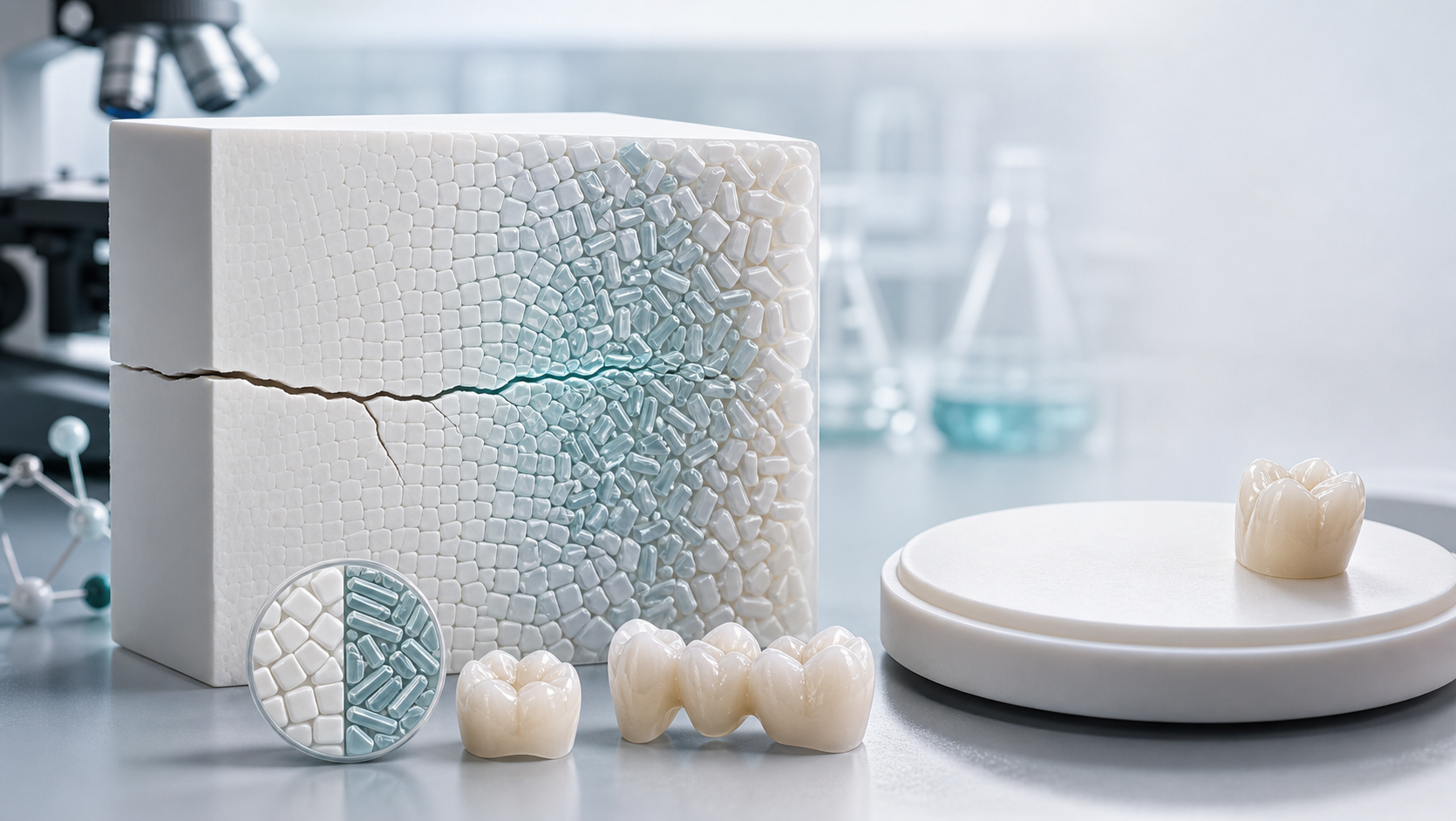
The Mechanism That Made Zirconia One of the Strongest Ceramics in Modern Dentistry
Central Question
Why does zirconia exhibit much higher mechanical strength than most other dental ceramics, even though it is a ceramic material?
The answer lies in a unique phenomenon known as Transformation Toughening. Unlike other dental ceramics, zirconia is able to respond to mechanical stresses through a localized transformation of its microstructure, hindering crack propagation and significantly increasing its resistance to fracture.
Introduction
In the previous chapter, we saw that zirconia can exhibit different crystalline phases and that the predominance of the tetragonal phase is directly related to the high mechanical strength of the material.
But an important question arises:
How can this crystalline phase increase the strength of zirconia so significantly?
The answer lies in an extremely sophisticated microscopic mechanism.
Small changes in composition can profoundly modify the behavior of zirconia. The tetragonal phase provides high mechanical strength through the mechanism of Transformation Toughening, considered the main factor responsible for the superior mechanical performance of this material. The monoclinic phase represents the product of this transformation, and its formation can be beneficial when it occurs locally, promoting a volumetric expansion that generates compressive stresses around the crack and hinders its propagation, or detrimental when it results from hydrothermal aging. The cubic phase, in turn, is responsible for increasing translucency.
The Problem with Conventional Ceramics
All ceramics exhibit high compressive strength, but a low capacity for plastic deformation.
When a crack develops in materials such as feldspathic porcelains or lithium disilicate, it usually continues to propagate until it causes fracture of the restoration.
This occurs because these materials have very limited mechanisms capable of preventing crack progression.
As a result, an initially imperceptible microcrack can slowly grow over time until it leads to clinical failure of the restoration.
What Makes Zirconia Different?
Zirconia has a unique characteristic among dental ceramics.
When high stresses become concentrated at the tip of a crack, part of the metastable tetragonal crystals locally transform into monoclinic crystals.
This transformation does not represent a failure of the material.
On the contrary, it is a natural defense mechanism that increases its resistance to crack propagation.
What Happens During the Transformation?
The transformation from the tetragonal phase to the monoclinic phase causes a localized volumetric expansion of approximately 3% to 5%. This expansion generates compressive stresses around the crack tip.
These stresses act in the opposite direction to crack growth, reducing its propagation rate and significantly increasing the fracture resistance of zirconia.
It is precisely this sequence of events that characterizes the mechanism of Transformation Toughening.
Why Does This Mechanism Work?
Instead of allowing the crack to advance freely, the zirconia microstructure itself reacts to the concentration of stresses.
The greater the tendency of the crack to propagate, the greater the probability that a localized transformation of the tetragonal phase will occur.
As a consequence, compressive stresses are formed, acting as a mechanical barrier to crack growth.
This active response distinguishes zirconia from most other ceramics used in dentistry.
A Simple Analogy
Imagine a crack trying to open in a wall. Now imagine that, exactly around that crack, the material itself expands and exerts a compressive force on the cracked region.
This compression makes it more difficult for the crack to continue growing, which is exactly what happens in zirconia.
The localized transformation from the tetragonal phase to the monoclinic phase creates a natural barrier against crack propagation.
The Role of Yttria
For this mechanism to function, the tetragonal phase must remain metastable at room temperature.
This condition is achieved by adding small amounts of yttrium oxide (Y₂O₃). Yttria stabilizes the tetragonal phase without completely preventing its transformation.
In this way, transformation to the monoclinic phase occurs only when there is a sufficient concentration of stresses, such as at the tip of a crack.
This balance is essential for the Transformation Toughening mechanism to function.
Why Does Strength Decrease as Yttria Increases?
As the yttria content increases, the amount of crystals with a cubic structure also increases. As a consequence, the fraction of metastable tetragonal phase available to participate in the Transformation Toughening mechanism decreases.
The result is a progressive reduction in zirconia’s ability to block crack propagation. In contrast, translucency increases, favoring esthetic performance.
This is the main reason why highly translucent zirconias exhibit lower mechanical strength when compared with traditional zirconias.
Comparison Among the Main Zirconias
| Zirconia Type | Predominant Phase | Transformation Toughening Potential |
|---|---|---|
| 3Y-TZP | Tetragonal | High |
| 4Y-PSZ | Tetragonal + cubic | Moderate |
| 5Y-PSZ | Higher cubic-phase content | Reduced |
The Role of Mechanical Fatigue
In the oral cavity, restorations rarely fracture because of a single excessive load. In most cases, failure results from the cumulative action of millions of masticatory cycles over the years, with each cycle potentially contributing to the gradual growth of existing microcracks.
The Transformation Toughening mechanism acts by slowing this process, reducing the rate of crack propagation and significantly increasing fatigue resistance.
This characteristic explains part of the excellent clinical longevity of zirconia restorations.
Clinical Translation
The Transformation Toughening mechanism explains why different generations of zirconia exhibit distinct biomechanical behaviors.
3Y-TZP zirconias, which are rich in the tetragonal phase, offer greater transformation toughening potential and remain the best option for extensive prostheses, posterior regions, and patients with high functional demands.
In contrast, 5Y-PSZ zirconias contain a greater amount of cubic phase, providing excellent esthetics but a lower ability to hinder crack propagation.
4Y-PSZ zirconias represent a balance between these two extremes, combining high mechanical strength with greater translucency.
Transformation Toughening — The mechanism by which phase transformation hinders crack propagation, increasing the toughness of the material.
Toughness — The ability of a material to resist the initiation and propagation of cracks.
Conclusion
The major differential of zirconia lies not only in its high mechanical strength values, but also in its ability to actively respond to concentrated stresses, hindering crack propagation through the mechanism of Transformation Toughening.
This phenomenon has made zirconia one of the most reliable ceramics in modern dentistry, enabling the development of restorations capable of withstanding high functional loads with excellent clinical predictability.
Understanding this mechanism is essential for interpreting the differences among the various generations of zirconia and selecting the most appropriate material for each restorative situation.
Kiwid Education Insight
The true differential of zirconia is not only its high initial strength, but its ability to respond to mechanical stresses before a microcrack progresses to fracture. It is this microscopic defense mechanism that explains why zirconia continues to be the main reference in strength among dental ceramics.
Next Article
04 - Yttria and Mechanical Strength
How yttria content transformed the evolution of dental zirconias.
Understanding the relationship among yttria, translucency, and strength is essential to understand why such different zirconias exist within the same family of materials.
References for this article
Garvie RC, Hannink RH, Pascoe RT. Ceramic steel? Nature. 1975;258:703–704. doi:10.1038/258703a0.
Chevalier J. What future for zirconia as a biomaterial? Biomaterials. 2006;27(4):535–543. doi:10.1016/j.biomaterials.2005.07.034.
Hannink RHJ, Kelly PM, Muddle BC. Transformation toughening in zirconia-containing ceramics. Journal of the American Ceramic Society. 2000;83(3):461–487. doi:10.1111/j.1151-2916.2000.tb01221.x.
Member discussion
Start the conversation
Sign in to start commenting.
Sign in