

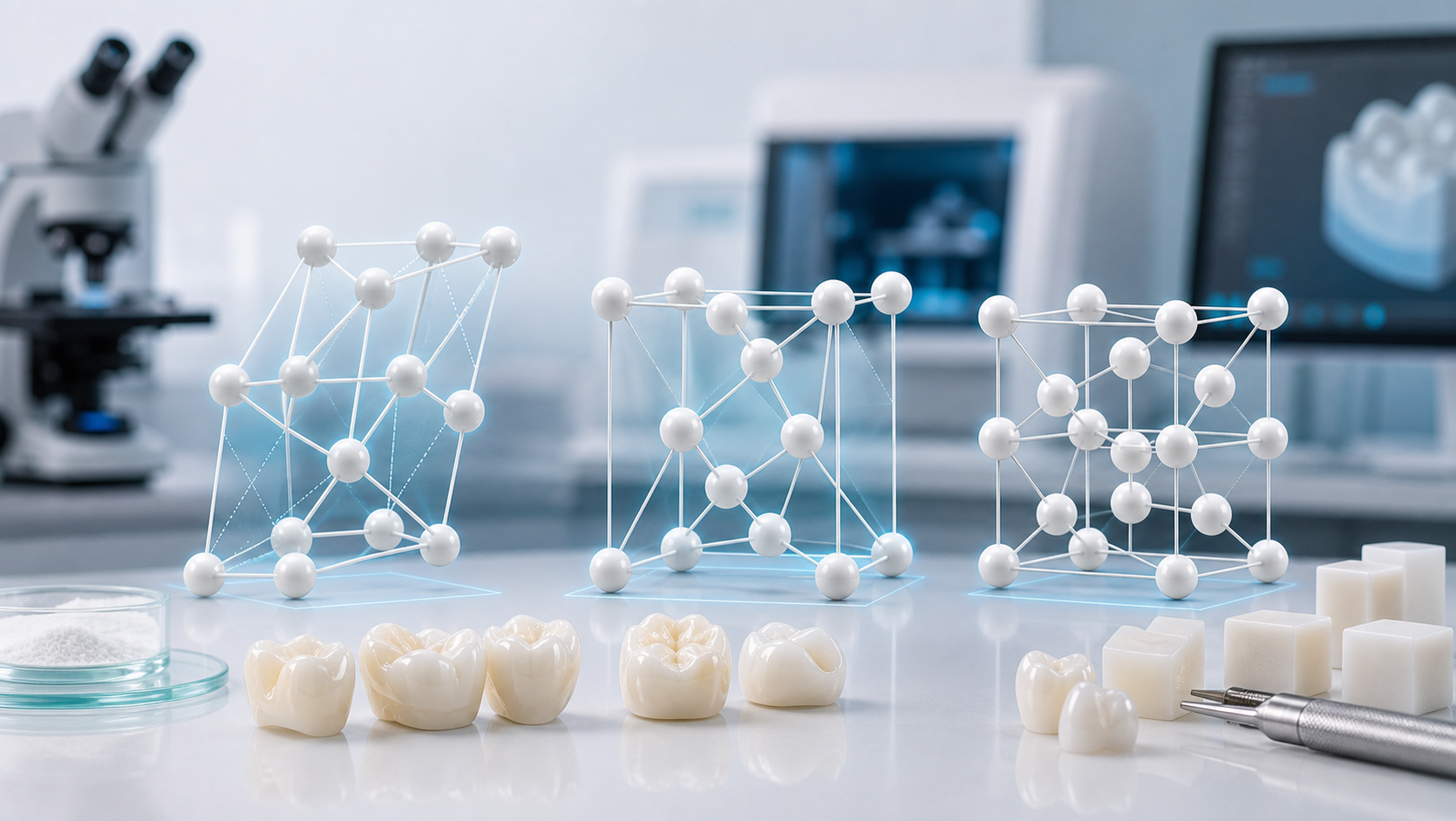
How Crystalline Phases Determine the Strength and Translucency of Zirconia
Central Question
Why do some zirconias exhibit exceptional mechanical strength, while others offer much higher levels of translucency?
The answer is directly related to the microstructure of the material and, more specifically, to the different crystalline phases present in zirconia. The proportion among the monoclinic, tetragonal, and cubic phases determines a large part of the mechanical, optical, and clinical properties of the material.
Small changes in this microstructure can profoundly modify its behavior. The greater the predominance of the tetragonal phase, the greater the mechanical strength tends to be. On the other hand, an increase in the cubic phase favors light transmission and significantly improves translucency.
Understanding these phases is essential to understand why different generations of zirconia exist and how to select the most appropriate material for each clinical situation.
Introduction
The zirconia used in dentistry is a polycrystalline material composed of zirconium dioxide (ZrO₂). Although its chemical composition remains practically unchanged, its crystalline structure can vary according to temperature and the amount of stabilizers added during manufacturing, especially yttrium oxide (Y₂O₃).
These different arrangements of the crystals are known as crystalline phases.
Each phase has its own characteristics and directly influences important properties such as mechanical strength, fracture toughness, translucency, and structural stability.
In dentistry, three phases are particularly important:
- monoclinic phase;
- tetragonal phase;
- cubic phase.
The balance among these phases is largely responsible for the evolution of the different generations of zirconia currently available.
What Are Crystalline Phases?
A crystalline phase corresponds to the way atoms are organized within the structure of the material.
Although the chemical composition remains zirconium dioxide (ZrO₂), small changes in crystalline organization can profoundly modify its physical and mechanical properties.
Among the main properties influenced by crystalline phases are:
- mechanical strength;
- fracture toughness;
- translucency;
- structural stability;
- behavior under mechanical stresses.
Therefore, materials with the same chemical composition can exhibit completely different clinical performance simply because of the proportion of crystalline phases present in their microstructure.
Monoclinic Phase
The monoclinic phase represents the most stable form of zirconia at room temperature when there is not a sufficient amount of stabilizers.
Main Characteristics
- lower mechanical stability;
- greater crystalline volume;
- limited direct application in dental restorations;
- associated with hydrothermal aging when present in excess.
Although it is normally considered an undesirable phase, its presence has great scientific importance because it participates in the structural transformations that occur in zirconia.
The role of this transformation will be discussed in the next chapter, dedicated to the mechanism of Transformation Toughening.
Tetragonal Phase
The tetragonal phase forms the basis of high-strength zirconias used in dentistry.
It predominates in zirconias classified as 3Y-TZP, being responsible for the excellent mechanical properties that have made this material one of the most reliable ceramics in restorative dentistry.
Main Characteristics
- high mechanical strength;
- high fracture toughness;
- high fatigue resistance;
- excellent clinical stability;
- ability to respond to mechanical stresses.
The main characteristic of this phase is its metastable condition, allowing it to respond to concentrated stresses in a way that is unique among dental ceramics.
This property forms the basis of the mechanism known as Transformation Toughening, which will be explained in detail in the next article.
Clinical Impact
The predominance of the tetragonal phase explains why 3Y zirconias continue to be the main choice for situations involving high functional demand, such as:
- patients with bruxism;
- extensive fixed prostheses;
- posterior regions;
- restorations subjected to high masticatory loads.
Cubic Phase
As the yttria concentration increases, part of the originally tetragonal crystals begins to exhibit a cubic structure, increasing the fraction of the cubic phase in the zirconia microstructure.
This change significantly modifies the optical behavior of the material and was one of the main factors responsible for the development of more translucent generations of zirconia.
The cubic phase exhibits less light scattering among the crystalline grains, allowing greater light transmission and providing an appearance closer to that of glass ceramics.
Main Characteristics
- high translucency;
- improved optical performance;
- lower light scattering;
- lower mechanical strength when compared with predominantly tetragonal zirconias.
Clinical Impact
Zirconias with a higher cubic-phase content are especially indicated for:
- anterior teeth;
- single crowns;
- restorations with high esthetic demands.
However, the increase in translucency is accompanied by a progressive reduction in mechanical strength, making it essential to select the material according to the clinical indication.
The Influence of Yttria
Yttrium oxide (Y₂O₃) is the main stabilizer used in the manufacturing of dental zirconias.
Its concentration determines the proportion among the different crystalline phases.
The higher the yttria concentration:
- the greater the amount of cubic phase;
- the greater the translucency;
- the lower the mechanical strength.
The lower the yttria concentration:
- the greater the amount of tetragonal phase;
- the greater the mechanical strength;
- the lower the translucency.
How Is This Reflected in Modern Zirconias?
| Zirconia Type | Predominant Phase | Main Characteristic |
|---|---|---|
| 3Y-TZP | Tetragonal | Maximum strength |
| 4Y-PSZ | Tetragonal + cubic | Balance between strength and esthetics |
| 5Y-PSZ | Higher cubic-phase content | Maximum translucency |
| Multilayer | Phase gradient | Cervical strength and incisal esthetics |
3Y-TZP - Yttria (3%) -Tetragonal Zirconia Polycrystal
4Y-PSZ - Yttria (4%) -Partially Stabilized Zirconia
5Y-PSZ - Yttria (5%) -Partially Stabilized Zirconia
Clinical Translation
The choice of zirconia should not be based only on the commercial brand or the level of translucency reported by the manufacturer.
The most important aspect is to understand the proportion of crystalline phases present in the microstructure of the material.
The higher the tetragonal-phase content, the greater the mechanical strength.
The higher the cubic-phase content, the better the optical behavior.
This relationship explains why different generations of zirconia have distinct clinical indications and reinforces the importance of selecting the material according to the biomechanical and esthetic requirements of each restoration.
Conclusion
The evolution of dental zirconias occurred mainly through the control of their crystalline phases.
By modifying the proportion between the tetragonal and cubic phases, it became possible to develop materials capable of offering different combinations of mechanical strength and translucency, significantly expanding their clinical applications.
Understanding these phases is the first step toward understanding why different generations of zirconia exhibit such distinct behaviors.
In the next article, we will see how the tetragonal phase uses a unique transformation mechanism to hinder crack propagation and make zirconia one of the strongest ceramics in modern dentistry.
Kiwid Education Insight
Crystalline phases do not represent only different atomic structures. They constitute a fundamental part of the scientific basis that explains the evolution of modern zirconias, from materials with maximum strength to the highly translucent generations used today.
Next Article
03 - The Importance of Transformation Toughening
The mechanism that made zirconia one of the strongest ceramics in modern dentistry.
Understanding the phenomenon known as Transformation Toughening is essential to understand why zirconia exhibits a biomechanical behavior different from that of any other dental ceramic.
References for this article
Scott HG. Phase relationships in the zirconia-yttria system. Journal of Materials Science. 1975;10(9):1527–1535. DOI: 10.1007/BF01031853.
Hannink RHJ, Kelly PM, Muddle BC. Transformation toughening in zirconia-containing ceramics. Journal of the American Ceramic Society. 2000;83(3):461–487. DOI: 10.1111/j.1151-2916.2000.tb01221.x.
Chevalier J, Gremillard L, Virkar AV, Clarke DR. The tetragonal-monoclinic transformation in zirconia: lessons learned and future trends. Journal of the American Ceramic Society. 2009;92(9):1901–1920. DOI: 10.1111/j.1551-2916.2009.03278.x.
Member discussion
Start the conversation
Sign in to start commenting.
Sign in